
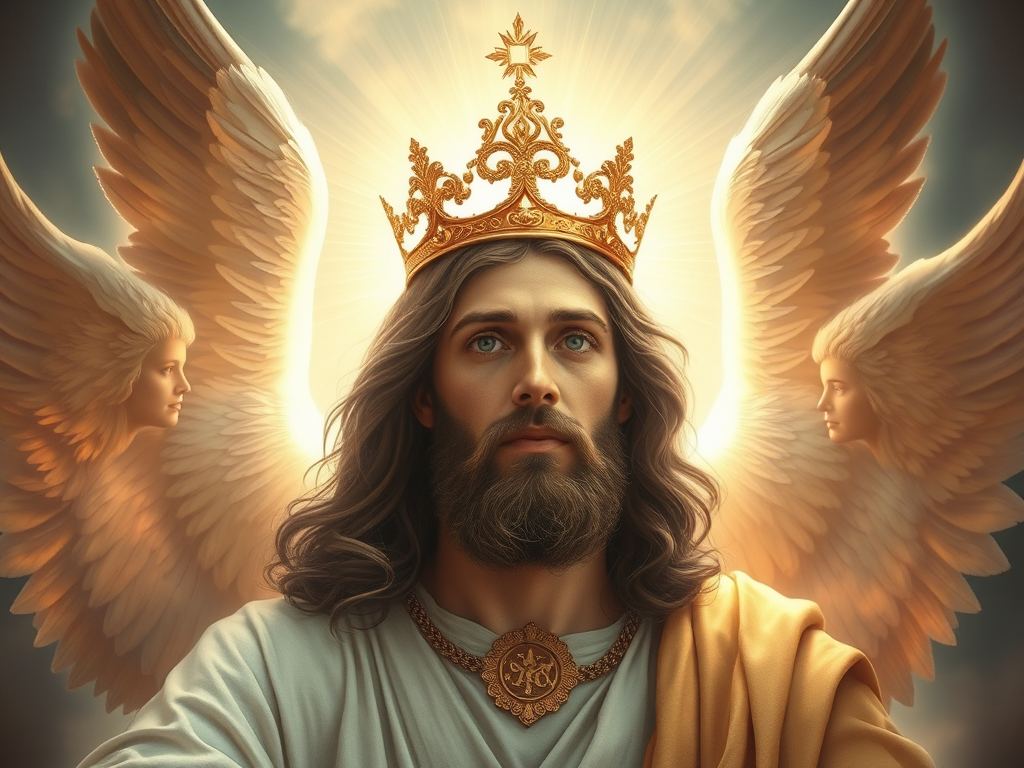
Man, Hebrews 1 is written like a theological hammer. There are a lot of things to pack here.
In verses 1–4, the author has already said things about the Son that cannot be true of a created angel:
- God made the world through the Son (Heb 1:2)
- the Son is the radiance of God’s glory (Heb 1:3)
- the Son is the exact imprint of God’s nature (Heb 1:3)
- the Son sat down at the right hand of Majesty (Heb 1:3)
So when Hebrews 1:5 begins with a comparison to angels, the author is not trying to introduce a new idea (like “Jesus was created”). He’s reinforcing what he already proved:
Jesus is categorically different from angels.
And the way he does it is by quoting Old Testament passages that describe royal sonship—the kind of sonship connected to rule, inheritance, enthronement, and authority.
The Driving Question: “Which Angel Did God Ever Say This To?”
Hebrews 1:5 starts with a rhetorical question:
“For to which of the angels did God ever say…?” (Hebrews 1:5)
This question assumes something:
- Angels may be called “sons of God” in the Old Testament (created beings in God’s heavenly host),
- but no angel was ever given the status described in these quotations.
So the point is not: “Jesus is a son, therefore He was created.”
The point is: “Jesus is the Son in a unique category—therefore angels are not peers.”
Why “Son” Language Does Not Automatically Mean “Created”
Modern readers hear “Father/Son” and think biology and origin. But the Bible often uses “son” language in a status sense:
- “son” can mean the one who represents the father’s authority
- “son” can mean the legal heir
- “son” can mean the one who shares in the father’s name and rule
Even on earth, “son of…” can mean likeness or identity (sons of thunder, son of encouragement, etc.). In Scripture, sonship language is often functional and covenantal, not biological.
That’s why the author can say the Son is eternal (Heb 1:2–3) and still quote “Son” texts from Israel’s royal theology (Heb 1:5).
The Two Old Testament Quotes in Hebrews 1:5
Hebrews quotes two famous Messianic texts:
1) Psalm 2:7
“You are my Son, today I have begotten you.”
2) 2 Samuel 7:14 (Davidic Covenant)
“I will be to him a father, and he shall be to me a son.”
Both are royal/kingly texts.
- Psalm 2 is about God installing His king over the nations.
- 2 Samuel 7 is about God’s covenant promise to David: an enduring royal line culminating in the Messiah.
So Hebrews is not grabbing random “Son” verses. He is intentionally pulling from enthronement/kingdom material.
The Big Trap: Thinking “Begotten” Must Mean “Created”
The word “begotten” makes modern readers jump to:
- “Jesus came into existence at a point”
- “Jesus was produced”
- “Jesus is a created being”
- or “Jesus was adopted as God’s Son later”
But here’s the key:
The New Testament itself tells you how it understands Psalm 2:7. And its usage does not support “created” or “adopted at baptism.”
Where Else Is “Today I Have Begotten You” Used?
This is one of the strongest arguments because it is purely biblical.
1) Acts 13:33 — Applied to the Resurrection
Paul says God fulfilled His promise:
“by raising Jesus… as it is written in the second Psalm: ‘You are my Son, today I have begotten you.’” (Acts 13:33)
So in Acts, “today I have begotten you” is connected to:
- resurrection
- vindication
- enthronement trajectory (resurrection → ascension → session at God’s right hand)
It is not connected to:
- Jesus being created
- Jesus being born
- Jesus being adopted at baptism
2) Hebrews 5:5 — Applied to Priest-King Appointment
Later in Hebrews, the author uses the same phrase again:
“Christ did not exalt himself to be made a high priest… but was appointed by him who said to him, ‘You are my Son, today I have begotten you.’” (Heb 5:5)
So in Hebrews 5, the phrase is tied to:
- appointment
- priesthood
- sacrificial work
- saving role
Not origin.
3) Hebrews 5:8 — Shows He Was Already the Son
Hebrews even says:
“Although he was a Son…” (Heb 5:8)
Meaning: He was the Son before the “today” statement is applied to His saving mission.
So “today I have begotten you” cannot mean “this is the day you became God’s Son.”
It’s not the start of sonship; it’s the public installation of sonship into a new stage.
So What Does “Today” Mean?
In royal Scripture language, “today” often refers to:
- the day of enthronement
- the day of coronation
- the day a king officially takes his seat and inheritance
Think of it like this:
A prince can be a prince for years, but there is a day he is publicly crowned and installed as king.
That day does not create his identity.
It announces his reign.
“Firstborn” Also Does Not Mean “First Created”
Hebrews 1:6 says:
“When he brings the firstborn into the world… let all God’s angels worship him.”
Again, many assume firstborn = first created.
But Scripture uses “firstborn” as a title of rank and inheritance, not chronology.
Exodus 4:22 — Israel Is Called “Firstborn”
“Israel is my firstborn son.” (Exod 4:22)
Israel is not the first people who ever existed.
So “firstborn” cannot automatically mean “first created.”
It means:
- chosen heir
- special status
- covenant priority
- representative authority
That’s exactly how Hebrews is using it:
the “firstborn” is the one angels must worship.
Why This Shuts Down Jehovah’s Witness-Style Arguments
Some groups quote:
“firstborn of all creation” (Col 1:15)
to claim Jesus is created.
But the very next verse says:
“For by him all things were created… in heaven and on earth… visible and invisible.” (Col 1:16)
If Jesus created all things, then He cannot be a created thing inside “all things.”
So either:
- the text means “all things,”or
- it doesn’t.
The logic is unavoidable:
Jesus is not created; He is the Creator.
That’s exactly what Hebrews is also saying.
The Flow of Hebrews 1 Makes the Meaning Obvious
Look at the order:
- The Son made purification for sins (Heb 1:3)
- The Son sat down at God’s right hand (Heb 1:3)
- Then come the enthronement quotes (Heb 1:5 onward)
So “today I have begotten you” fits perfectly as:
the announcement of the Son’s enthronement after His finished work.
Resurrection and ascension are not “the moment Jesus becomes divine.”
They are the moment the divine Son’s kingship is publicly inaugurated in history.
A Simple Paraphrase of Hebrews 1:5
When Hebrews quotes:
“You are my Son, today I have begotten you”
it is essentially saying:
“You have now taken your throne and inheritance. You have completed your priestly sacrifice. You have been raised and enthroned. Now rule with Me.”
This is kingship language.
And immediately after that, Hebrews quotes the Davidic covenant:
“I will be to him a father, and he shall be to me a son.”
That covenant is about the King.
Conclusion: Hebrews 1:5–9 Is Not About Origin—It’s About Supremacy
Hebrews 1 does not move backward into “Jesus was created.”
It moves forward into:
- Christ’s enthronement
- Christ’s inheritance
- Christ’s superiority over angels
- Christ receiving worship
- Christ ruling forever
“Begotten” here is not a statement about Jesus coming into existence. It is a declaration of the enthroned King: the unique Son who shares God’s name, God’s rule, and God’s throne.
References
Michael Heiser, Naked Bible Podcast
Continue reading
Previous in the Hebrews series: Did Jesus Become Son in Time?
Next in the Hebrews series: Angel’s Worship of Jesus Proves He is Greater
Related reading:


Leave a Reply