
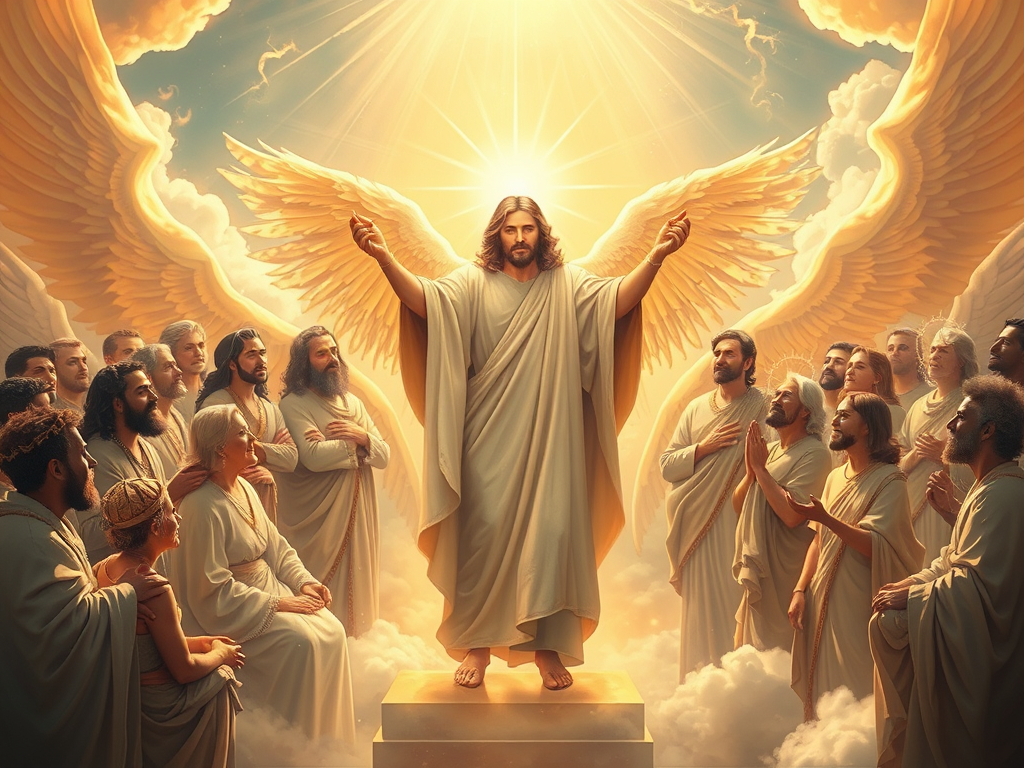
Hebrews opens with one of the most powerful Christological statements in the New Testament:
“But in these last days He has spoken to us by his Son, whom He appointed the heir of all things, through whom also He created the world.” — Hebrews 1:2
At first glance, the verse seems straightforward. God once spoke through prophets; now He speaks through His Son. But when we look more closely—especially at the Greek text—an important nuance emerges, one that sharpens the author’s argument in a striking way.
The Greek Detail Many Miss
In the Greek text of Hebrews 1:2, something unexpected appears.
There is:
- No definite article (“the”)
- No possessive pronoun (“his”)
The phrase translated “by his Son” is literally:
ἐν υἱῷ — “by a son”
Most English translations smooth this out as “his Son,” and theologically that is correct. But grammatically, the author chose a construction that is deliberately anarthrous—a son, not the Son.
This is not a mistake. And it is not insignificant.
Why the Author Would Say “a Son”
Many commentators acknowledge the grammar but move past it quickly, assuming the phrasing is merely stylistic. However, when read against the Old Testament background, especially the biblical concept of the divine council, the choice becomes far more meaningful.
In the Old Testament, God is not described as solitary in His heavenly realm. Scripture repeatedly speaks of:
- sons of God
- heavenly beings
- a divine council surrounding YHWH
These “sons” are real created beings, but they are not equals, creators, or heirs. Against that backdrop, Hebrews is doing something brilliant.
The Contrast the Author Is Making
The opening sentence of Hebrews establishes a contrast:
- Formerly: God spoke through prophets
- Now: God speaks through a son
But the contrast does not stop there. By saying “a son”, the author implicitly acknowledges that:
- God has many sons in the heavenly realm
- Yet this Son is categorically different
In other words, the phrasing does not diminish Christ—it magnifies Him. The thought can be paraphrased this way:
“In these last days, God has spoken to us by one particular Son—distinct from all the others—whom He appointed heir of all things, and through whom He created the world.”
This one Son is set over against every other son. Please do not get mistaken! Every other “son” was created, but Jesus is the only eternal, sovereign, Son, who is the express image of God.
Why the Divine Council Context Matters
Without a divine council framework, the phrase “a son” feels awkward or even theologically risky. With it, the phrase becomes razor-sharp.
The author of Hebrews is not saying:
- Jesus is one son among many equals
He is saying:
- Out of all who could be called “sons,” this Son alone:
- Is heir of all things
- Is the agent of creation
- Sustains all things
- Receives worship
- Sits at God’s right hand
Hebrews 1 will immediately go on to say:
“To which of the angels did God ever say, ‘You are my Son’?”
The answer is obvious: none. Angels and other sons of God, were sons, but to none did God say MY SON.
“A Son” Who Created the World
The verse itself prevents any misreading.
This “Son” is the one:
- Through whom God created the world
- Whom God appointed heir of all things
No created heavenly being fits that description. So the grammar does not lower Christ—it isolates Him.
He is not:
- One voice among many
- One mediator among equals
- One son in a class of sons
He is the unique Son, highlighted precisely by being introduced as one particular Son set apart from all others.
Why This Strengthens the Argument of Hebrews
Hebrews is not merely arguing that Jesus is better than prophets.
It is arguing that Jesus is:
- Superior to angels
- Superior to every heavenly power
- Superior to every prior mode of revelation
By beginning with “a son,” the author draws the reader into a heavenly comparison—and then decisively ends it.
There may be many sons.
There is only one Son through whom creation itself exists.
A Better Way to Hear Hebrews 1:2
Read with this emphasis, the verse sounds like this:
In these last days, God has spoken—not by prophets, not by angels—but by one particular Son, distinguished from all others, appointed heir of all things, and the very agent through whom the world was made.
That is not a grammatical curiosity.
That is high Christology.
Conclusion
Hebrews 1:2 does not weaken the identity of Christ by saying “a son.”
It intensifies it.
By using language that acknowledges other “sons” while immediately excluding them from creation, inheritance, and glory, the author makes the contrast unmistakable.
God has spoken in many ways.
God has spoken through many servants.
But in these last days, He has spoken by a Son unlike any other.
And that Son stands alone.
Continue reading
Previous in the Hebrews series: How Did God Make The World Through Jesus
Next in the Hebrews series: Jesus, The Exact Representation of God
Related reading:


Leave a Reply