

“In these last days God has spoken to us in His Son…”
—Hebrews 1:2 (Greek: ἐν υἱῷ, en huiō)
Most English translations soften this verse to say God spoke “through” or “by” His Son.
But that is not what the Greek says.
The writer of Hebrews chooses a different, richer, more profound expression:
God has spoken in His Son.
This is one of the most important statements in the entire New Testament.
It tells us how God reveals Himself — not just in words, but in a Person.
Let’s explore why this matters.
1. The Greek Grammar Matters — “In His Son,” Not Merely “Through His Son”
Hebrews 1:2 uses the phrase:
ἐν υἱῷ — en huiō meaning “in a Son”, or “in His Son.”
The writer does not use the normal Greek preposition for “through” (διά / dia).
This means:
- God is not merely communicating a message through Jesus
- God is communicating Himself, in Jesus
Jesus is not just the carrier of revelation. He is the revelation. He does not simply speak God’s words. He embodies God’s Word. He is not simply the messenger. He is the Message made flesh.
2. “In His Son” Means Revelation Is Personal, Not Just Propositional
When prophets spoke, they delivered messages from God. When Jesus came, He delivered God Himself.
In the Old Covenant:
- God sent words.
- God sent visions.
- God sent dreams.
- God sent prophetic servants.
In the New Covenant:
God sent Himself.
John 1:14 describes it perfectly:
“The Word became flesh and dwelt among us.”
Jesus doesn’t just tell us what God is like — He shows us God in human form.
This is why Hebrews immediately says:
“He is the radiance of God’s glory and the exact representation of His nature.” —Hebrews 1:3
Not a reflection. Not an approximation. Not a shadow. An exact representation.
Everything God wishes to reveal is found in the Son.
3. “In His Son” Means Jesus Is the Location of Revelation
If someone asks, “God reveal yourself to me” The New Testament answers:
“Look at Jesus.”
- His kindness reveals God’s kindness.
- His compassion reveals God’s compassion.
- His authority reveals God’s authority.
- His purity reveals God’s holiness.
- His teaching reveals God’s truth.
- His forgiveness reveals God’s heart.
- His death reveals God’s love.
- His resurrection reveals God’s victory.
Revelation is no longer scattered through prophets. It is concentrated in one Person. To know Jesus is to know God.
4. “In His Son” Means Jesus Is the Final and Complete Revelation
This is the contrast Hebrews builds:
Before:
God spoke in fragments — many portions, many ways, many voices.
Now:
God has spoken in one final, perfect, complete revelation — His Son.
Every prophet gave part of the picture. Jesus gives the whole picture.
There is no “next revelation.” No greater messenger is coming.
No prophet surpasses Him. No vision adds to Him.
Jesus is the climax, not a chapter.
He is the substance, not the shadow.
He is the final word, not another voice in the line.
5. “In His Son” Means God Came Near — Close Enough to Touch
In the Old Covenant, God spoke from a distance:
- through burning bushes
- through thunder
- through priests
- through prophets
- through sacred spaces
But now?
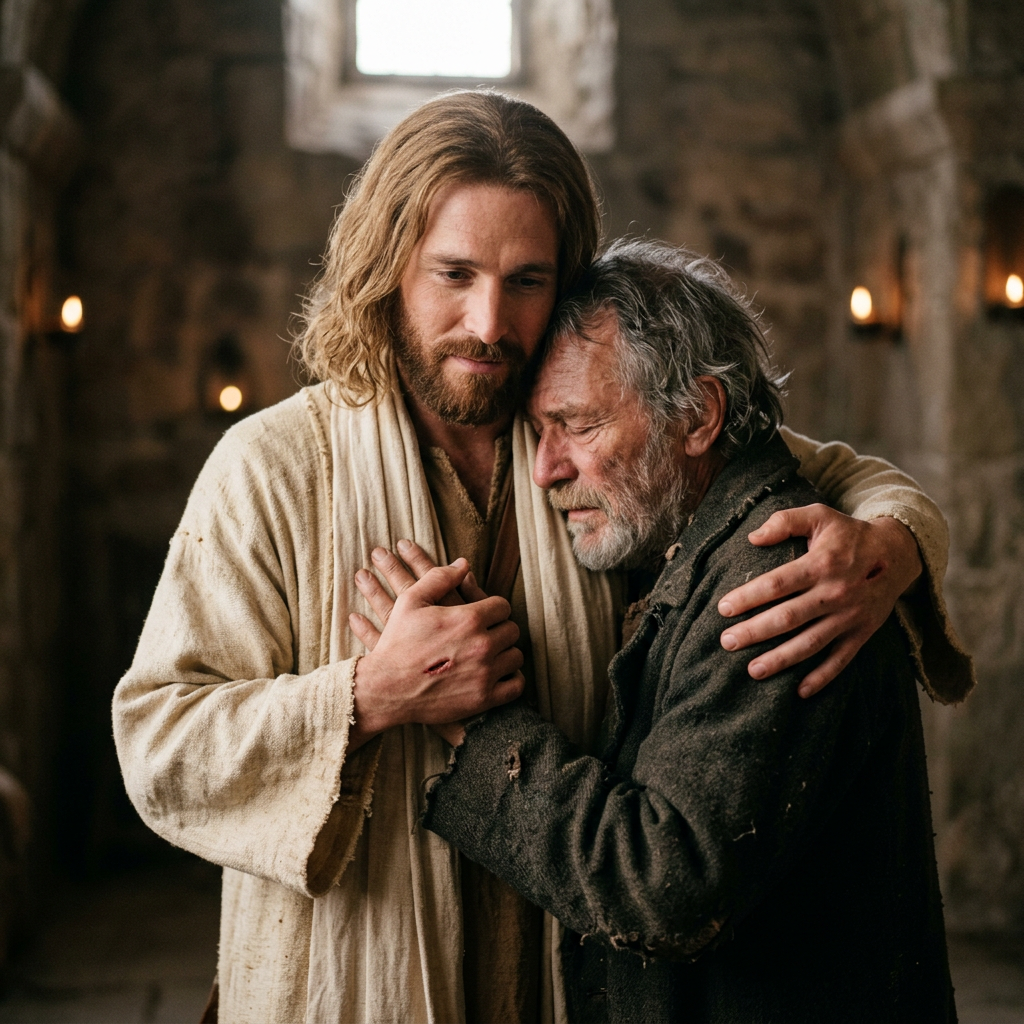
He speaks in a Son —one who eats with sinners, touches lepers, washes feet, breaks bread, suffers, dies, rises, and reigns.
God’s revelation has a face.
God’s word has hands.
God’s truth has a heartbeat.
Jesus is God’s nearness in human form.
6. “In His Son” Means Revelation Is Finished — But Our Understanding Continues
While God’s revelation is complete in Christ, our comprehension grows over time.
We keep discovering more of what God has already fully revealed in Him:
- His finished work
- His identity
- His authority
- His priesthood
- His grace
- His new covenant
- His glory
Hebrews begins its majestic journey by declaring:
“God has spoken in His Son.”
The rest of the book explains what that means.
In One Sentence
Hebrews 1:2 teaches that Jesus Himself — His person, His life, His nature — is God’s final and perfect revelation. God has spoken not just through His Son’s words but in His Son’s very being.
Continue reading
Previous in the Hebrews series: How God Spoke Then and Now
Next in the Hebrews series: He Owns Everything Already
Related reading:


Leave a Reply