
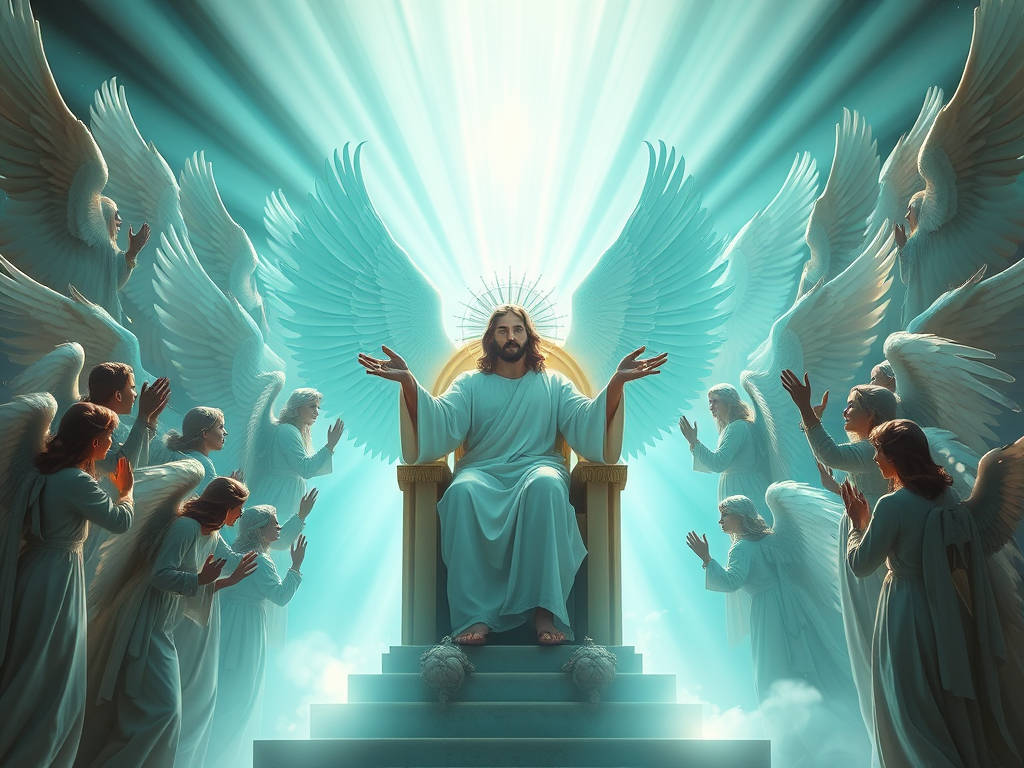
“Having become as much better than the angels,
as He has inherited a more excellent name than they.”
— Hebrews 1:4
The opening chapter of Hebrews is a majestic unveiling of who Jesus truly is. The author confronts the Jewish assumption that angels were the highest created beings—glorious, powerful, and heavenly. But Hebrews makes something unmistakably clear:
Jesus is infinitely superior to them.
Yet the way Hebrews explains this superiority is surprising:
“Having become much better than the angels…”
The eternal Son became superior?
Let’s walk through what this means.
1. “Having Become”: A Change of Position, Not a Change of Nature
The Greek verb genomenos (“having become”) refers to a change of position or status—not a change of essence.
✔ Jesus did not become God.
✔ Jesus did not change His divine nature.
✔ Jesus did experience a change in public position through resurrection and exaltation.
This follows the pattern of His mission:
A. Humiliation
- He was made lower than the angels (Heb. 2:9)
- He emptied Himself (Phil. 2:6–7)
- He took the form of a servant
- He suffered and died
B. Exaltation
- He rose
- He ascended
- He sat down at the right hand of God
- He inherited a more excellent name
- He became superior to angels in revealed glory
This “becoming” refers to His Messianic exaltation, not His deity.
2. Why Angels Matter in Hebrews
To a Jewish audience:
- Angels mediated the Law (Deut. 33:2; Acts 7:53; Gal. 3:19).
- Angels were seen as heavenly guardians.
- Angels were viewed as cosmic rulers.
- Some believed Michael might surpass the Messiah.
Hebrews dismantles these ideas by showing:
If angels are great, Jesus is infinitely greater.
They serve. He reigns.
They worship. He is worshiped.
This is not a minor correction; it is a cosmic reorientation.
3. “He Inherited a More Excellent Name” — The Name “SON”
The “more excellent name” is the name Son.
How do we know?
Because Hebrews 1:5 explains verse 4:
“For to which of the angels did He ever say,
‘You are My Son, today I have begotten You’?”
The word “For” makes it clear:
- Verse 5 defines the “more excellent name.”
- The name quoted is Son.
- The contrast is: Jesus is Son, angels are servants.
Why “Son” matters:
- “Son” expresses divine identity.
- “Son” expresses unique relationship with the Father.
- “Son” expresses inheritance and authority.
Jesus did not become the Son—He was eternally the Son.
But He inherited or publicly received the title “Son” as the exalted, enthroned Messiah after completing redemption.
This is a coronation moment—not a creation moment.
4. Why Did He Need to “Become” Higher Than Angels?
Because redemption required that He go lower first.
Hebrews 2:9:
“For a little while He was made lower than the angels…”
Not because He ceased to be God,
but because He entered true humanity.
He had to:
- take on flesh
- walk in mortality
- suffer death
- bear sin
- finish purification
Only then could He:
- destroy death
- defeat the devil
- rise in victory
- be enthroned
- be declared Son in power
His exaltation is His vindication.
He descended to save,
He ascended to reign.
5. The Exalted Son vs. Mighty Angels
Hebrews 1 contrasts Jesus with angels in seven majestic ways:
- He is the Son — they are servants.
- He is worshiped — they worship.
- He rules — they are winds and flames.
- His throne is eternal — their ministry is temporary.
- He laid the foundation of the earth — they did not.
- He is unchanging — they are mutable.
- He sits at God’s right hand — they never do.
No angel is called Son.
No angel is invited to the throne.
No angel holds the scepter of righteousness.
Jesus alone bears the name that angels obey:
Son of God.
6. What This Means for Us
A. Your Savior reigns.
You follow One enthroned, not struggling.
B. Your salvation is complete.
He sat down because purification is finished.
C. Your faith is anchored in Someone infinitely superior.
Not angels.
Not prophets.
Not Moses.
But the exalted Son.
D. You share in His victory.
The exalted Son is the One who united Himself to you.
E. You can live free from fear of spiritual powers.
If angels are servants and the Son is Lord,
and you are in Him,
what is left to fear?
Conclusion: The Name Above Every Name in Hebrews Is “Son”
Hebrews 1:4 lifts our eyes to the supremacy of Jesus:
- He humbled Himself
- He became lower than angels
- He finished purification
- He sat down
- He inherited the name Son
- He was exalted above every created being
He became superior in revealed glory
because He completed a superior salvation.
The angels worship Him.
The heavens adore Him.
The church proclaims Him.
And creation will bow before Him.
This is the Christ we believe in—
not an elevated angel,
not merely a great teacher,
but the eternal, exalted Son of God
who inherited the name above every name:
SON.
Continue reading
Previous in the Hebrews series: How This Word in Hebrews 1:3 Identifies Jesus as Eternal Wisdom
Next in the Hebrews series: The Son Enthroned Above Angels
Related reading:


Leave a Reply