

It’s been a few weeks of war already and one thing has upset me:
Christians are using the language of God’s enemies to justify hatred, war, and violence.
“God destroys his enemies.”
“We’re fighting his battles.”
“They deserve judgment.”
It sounds spiritual.
It sounds righteous.
And it is completely, dangerously wrong — at least if you actually read what Jesus did.
“For God was pleased to have all his fullness dwell in him, and through him to reconcile to himself all things, whether things on earth or things in heaven, by making peace through his blood, shed on the cross.”— Colossians 1:19–20
All things.
Not some things.
Not the people we happen to like.
All things.
The cross was not a weapon — it was a peace treaty.
And that treaty was signed in blood on behalf of people who were still enemies of God at the time (Romans 5:10).
That’s the scandal of grace: the reconciliation happened while humanity was still hostile. The war, from God’s side, is over.
The only question is whether we’ve accepted the terms.
The math of the New Covenant
Paul couldn’t be clearer about what this means for how we see people:
“Therefore, if anyone is in Christ, the new creation has come: The old has gone, the new is here! All this is from God, who reconciled us to himself through Christ and gave us the ministry of reconciliation: that God was reconciling the world to himself in Christ, not counting people’s sins against them.”— 2 Corinthians 5:17–19
Not counting people’s sins against them. That’s not soft theology. That’s the posture of the living God toward a broken world.
And if that is God’s posture — the one who actually has the right to keep score — what exactly is our excuse for drawing enemy lines?
The New Covenant doesn’t just soften the old categories.
It obliterates them.
Paul goes on to say we are “ambassadors for Christ” (v.20) — and ambassadors don’t fight the people they’re sent to. They carry a message. And the message is: be reconciled to God.
Jesus was direct about this
Jesus didn’t leave any theological wiggle room here. Not even a crack:
“But I tell you, love your enemies and pray for those who persecute you, that you may be children of your Father in heaven.”— Matthew 5:44–45
“You have heard that it was said, ‘Love your neighbor and hate your enemy.’ But I tell you: Love your enemies.”— Matthew 5:43–44
Notice what Jesus is doing: he’s quoting a popular religious tradition (“love your neighbor, hate your enemy”) and then replacing it entirely.
He didn’t say “well, balance it out” or “love your enemies but also defend your tribe.”
He said love them. Full stop.
And then he anchored it in the character of God himself — because God sends rain on the just and the unjust alike (v.45).
God’s posture toward his enemies is generosity.
Paul dismantles the walls entirely
“For he himself is our peace, who has made the two groups one and has destroyed the barrier, the dividing wall of hostility… His purpose was to create in himself one new humanity out of the two, thus making peace.”— Ephesians 2:14–15
The “two groups” here were Jews and Gentiles — people who had deep, centuries-old reasons to see each other as enemies.
And Paul says: that wall is gone.
Christ didn’t just call a ceasefire. He tore the wall down at the cross and built something new in its place — one new humanity. Not two groups learning to tolerate each other. One new thing altogether.
So when Christians today rebuild that wall — drawing it between nations, races, political parties, or ideologies — and call it God’s battle, they are working against what Christ built with his death.
That’s not faithfulness. That’s demolition work on the cross.
“When we name enemies, we are undoing what Christ did. He made peace. We are restarting the war.”
Even the book of Romans
Paul, who once hunted Christians and called himself the worst of sinners (1 Timothy 1:15), wrote this:
“Do not repay anyone evil for evil… If your enemy is hungry, feed him; if he is thirsty, give him something to drink… Do not be overcome by evil, but overcome evil with good.”— Romans 12:17, 20–21
This is not passivity.
This is aggressive, costly, intentional love toward the people who least deserve it — which is, by the way, exactly how we were loved.
None of us deserved it either.
The entire logic of the gospel is that God loved us when we were enemies (Romans 5:8). To turn around and identify new enemies to destroy is to amputate the very root from which our own salvation grew.
So where does this leave us?
The hard truth is this:
in the New Covenant, the category of “enemy to be destroyed” has been emptied out and replaced with “person to be loved.”
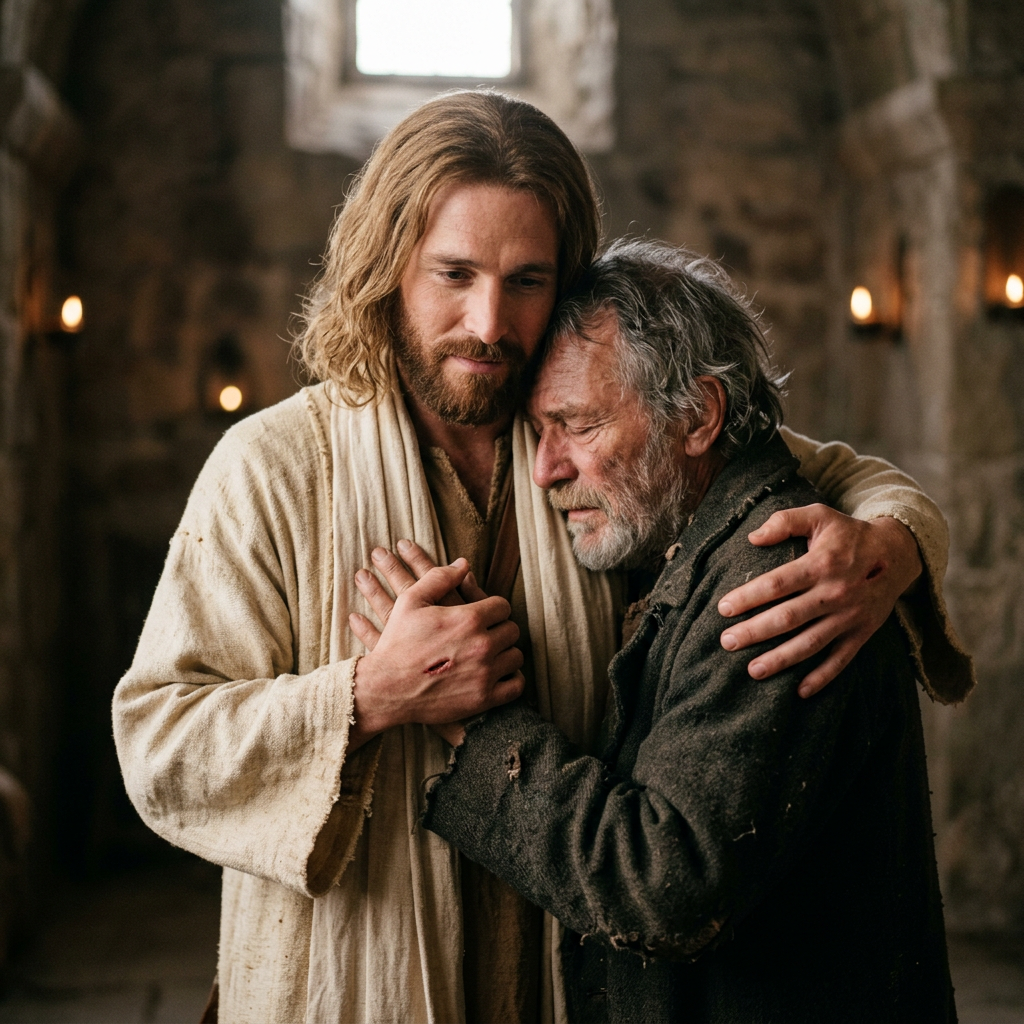
Every person — every single one — is someone Christ died for.
Every person is someone the Father is not counting sins against.
Every person is someone we are sent to as ambassadors of reconciliation.
The Old Testament wars, God’s wrath poured out on Canaan, the destruction of enemies — all of that was pointing forward to a cross where God absorbed his own wrath and offered peace to the whole world.
To rip those passages out of that arc and use them to justify violence today is to read the Old Testament as if Jesus never came. It’s to act as if the curtain is still whole, the temple still standing, and the age of grace hasn’t dawned.
But it has. He came. He died. He rose. And the war is over.
The only question now is: will we live like it?
If this challenged you, sit with Matthew 5:43–48 today. Read it slowly. Ask yourself honestly: who have I been treating as an enemy that God is calling me to love?
The gospel isn’t just good news for us. It’s the end of every wall we’ve ever built. That’s the salt we’re called to be.
Continue reading
Related reading:


Leave a Reply