
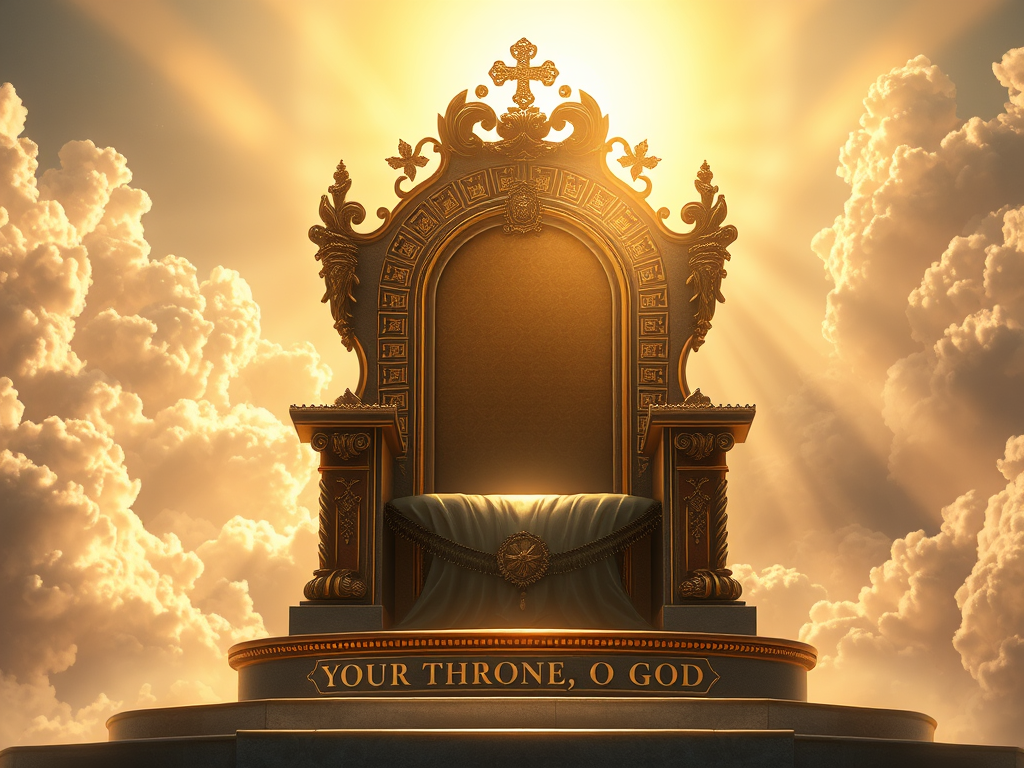
“But of the Son He says,
‘Your throne, O God, is forever and ever,
and the righteous scepter is the scepter of His kingdom.’”—Hebrews 1:8
Hebrews 1:8 is one of the most direct, unambiguous statements of Christ’s deity in the entire New Testament.
This is not a theologian speaking.
This is not an apostle making an inference.
This is God the Father speaking about the Son.
And what does He say?
“Your throne, O God…”
No qualifiers.
No metaphors.
No softened language.
The Father calls the Son God.
1. The Context: Angels vs the Son
Hebrews 1 is structured as a deliberate contrast.
- Angels are servants
- The Son is King
- Angels minister
- The Son reigns
In verse 7, angels are described as winds and flames of fire—powerful, effective, but instrumental.
Then verse 8 begins with a decisive contrast:
“But of the Son He says…”
The shift is intentional.
Angels are described.
The Son is addressed.
And the address is staggering.
2. This Is Not Poetic Hyperbole — It Is a Divine Address
Some attempt to soften Hebrews 1:8 by arguing:
- It is merely royal language
- It is figurative
- It refers to God acting through the Son
But the grammar does not allow this.
The Greek is clear:
Ὁ θρόνος σου ὁ Θεὸς
“Your throne, O God”
This is a vocative address, not a description.
God is not saying:
- “Your throne is God-like”
- “Your throne belongs to God”
He is saying:
“You are God, and this is Your throne.”
3. The Father Is Quoting Psalm 45 — and Reapplying It
Hebrews 1:8 quotes Psalm 45, a royal psalm originally associated with Israel’s king.
But Hebrews does something radical.
It declares that Psalm 45 was never ultimately about an earthly king.
It was always:
- Messianic
- Forward-looking
- Fulfilled only in Christ
The earthly throne faded.
The true throne remains.
This is not a promotion of Jesus.
It is a revelation of who He has always been.
4. “Your Throne Is Forever and Ever”
Earthly kings reign temporarily.
Dynasties rise and fall.
Empires decay.
But the Son’s throne is:
- Eternal in duration
- Unshakeable in authority
- Final in scope
This matters deeply for salvation.
If Christ’s throne were temporary,
our redemption would be insecure.
But because His reign is eternal:
- His priesthood does not expire
- His covenant does not end
- His righteousness does not fade
Our hope is anchored not in a system,
but in a Person who reigns forever.
5. The Righteous Scepter: What Kind of King Is This?
“The righteous scepter is the scepter of His kingdom.”
His authority is:
- Perfectly just
- Perfectly holy
- Perfectly aligned with God’s nature
This is why His rule brings peace, not fear.
His throne does not threaten the believer.
It secures them.
6. This Verse Collapses False Categories
Hebrews 1:8 leaves no room for:
- Jesus as merely a created being
- Jesus as the highest angel
- Jesus as a secondary divine agent
The Father Himself draws the line.
Angels are never called God.
Prophets are never addressed this way.
Kings are never spoken to like this.
Only the Son.
7. Why This Matters for the New Covenant
If Jesus were not God:
- His sacrifice would be insufficient
- His priesthood would be temporary
- His authority would be borrowed
But because the Son is God:
- His work is final
- His mediation is complete
- His reign is absolute
The new covenant does not rest on angelic mediation, law, or ritual.
It rests on:
A throne occupied by God the Son.
Final Reflection: The Gospel According to Hebrews 1:8
Hebrews 1:8 is not an abstract doctrinal statement.
It is gospel.
The One who purified our sins (Heb 1:3)
is the same One the Father calls God.
The One who bore our weakness
now rules from an eternal throne.
And the One who reigns forever
reigns for us, not against us.
This is not merely high Christology.
This is unshakable assurance.
Because if the Son is God,
then salvation is not fragile.
It is enthroned.
Continue reading
Previous in the Hebrews series: Angel’s Worship of Jesus Proves He is Greater
Next in the Hebrews series: Your Throne, O God
Related reading:
One response to “Did The Father Ever Call Jesus God? Yes: Heb 1:8”
-
Struggling with my beliefs in the trinity- this was helpful. God bless


Leave a Reply