
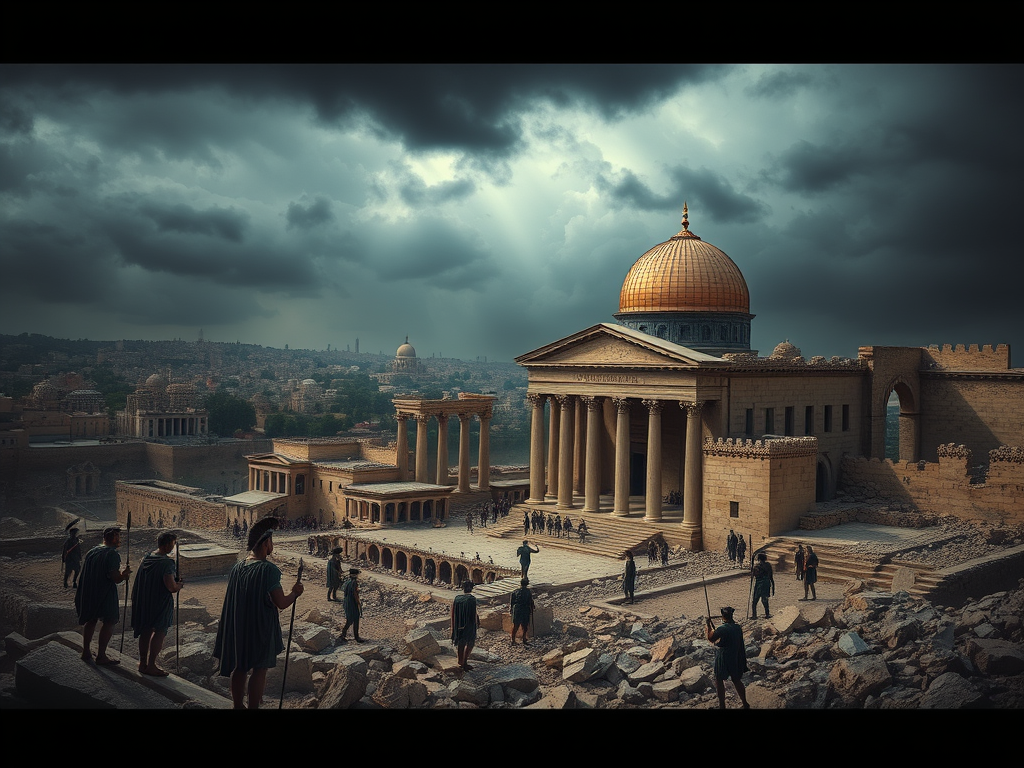
Introduction: Jesus’ Prophecy on the Mount of Olives
When Jesus’ disciples asked Him about the destruction of the temple, the sign of His coming, and the end of the age (Matthew 24:3), He gave what we now call the Olivet Discourse.
Dispensationalists see this as a blueprint for a future 7-year tribulation and Antichrist. But from a Finished Work perspective, much of this prophecy was fulfilled in AD 70, when the Romans destroyed Jerusalem — a direct outworking of Christ’s finished work.
1. The Context: Temple Destruction Foretold
Jesus begins with a shocking declaration:
“Truly I tell you, not one stone here will be left on another; every one will be thrown down.” (Matthew 24:2)
This prophecy came true in AD 70, when Rome razed the temple. Jesus’ words were not speculation about a far-off tribulation but a warning of a judgment that would fall on His generation.
“Truly I tell you, this generation will certainly not pass away until all these things have happened.”(Matthew 24:34)
2. Signs of the End of the Temple Age
Jesus listed wars, famines, earthquakes, and persecution (Matthew 24:6–9). Dispensationalists say these are “birth pains” before a future tribulation.
Finished Work teaching sees them as first-century realities leading up to AD 70. Early Christians experienced persecution, famine (Acts 11:28), and the Jewish wars that culminated in Jerusalem’s fall.
3. The Abomination of Desolation
“So when you see standing in the holy place ‘the abomination that causes desolation’…” (Matthew 24:15)
Dispensationalists say this is Antichrist in a future temple.
Finished Work theology connects it to Rome’s desecration of the temple in AD 70, just as Luke records:
“When you see Jerusalem being surrounded by armies, you will know that its desolation is near.” (Luke 21:20)
Luke interprets Daniel’s language historically, not futuristically.
4. Cosmic Language of Judgment
Jesus speaks of the sun darkened, stars falling, and heavenly powers shaken (Matthew 24:29). Dispensationalists see this as literal astronomical chaos at the end of time.
But the prophets often used cosmic language for covenantal judgment:
- Isaiah 13:10 — stars darkened describing Babylon’s fall.
- Ezekiel 32:7–8 — sun and moon darkened for Egypt’s downfall.
In the same way, Jesus was describing the end of the Old Covenant world, not the end of the physical universe.
5. The Son of Man Coming on the Clouds
“Then will appear the sign of the Son of Man in heaven… and they will see the Son of Man coming on the clouds of heaven with power and great glory.” (Matthew 24:30)
Dispensationalism: a visible second coming after tribulation.
Finished Work: this is not about Jesus leaving heaven, but about His vindication and enthronement, echoing Daniel 7:13–14. “Coming on the clouds” is the language of judgment and authority, fulfilled in AD 70 when Christ’s words were vindicated.
6. But What About the Final Return?
Amillennialism doesn’t deny the final coming of Christ. The Olivet Discourse weaves together near-term prophecy (AD 70) and ultimate hope (the end of the age). The destruction of Jerusalem was the sign that Jesus was enthroned and His kingdom had come. What remains is the final unveiling — resurrection and new creation.
7. Key Contrast
- Dispensationalism: Olivet Discourse is mostly about a future 7-year tribulation. Antichrist will desecrate a rebuilt temple, and cosmic signs will signal Christ’s second coming.
- Finished Work Amillennialism: Olivet Discourse is about AD 70 as the covenantal judgment on Israel’s rejection of Christ. The “coming” is about vindication and enthronement. The final return is still future but not tied to a tribulation chart.
Conclusion: The End of the Temple Age, Not the End of Hope
The Olivet Discourse was not designed to fuel endless speculation. It was Jesus’ way of telling His disciples: the old is passing, the new has come.
“Therefore, if anyone is in Christ, the new creation has come: The old has gone, the new is here!” (2 Corinthians 5:17)
AD 70 confirmed that Christ’s work was finished and the Old Covenant had ended. Now, our hope rests not in fear of tribulation, but in the certainty of His final appearing to raise the dead and renew all things.
Continue reading
Related reading:

Leave a Reply