
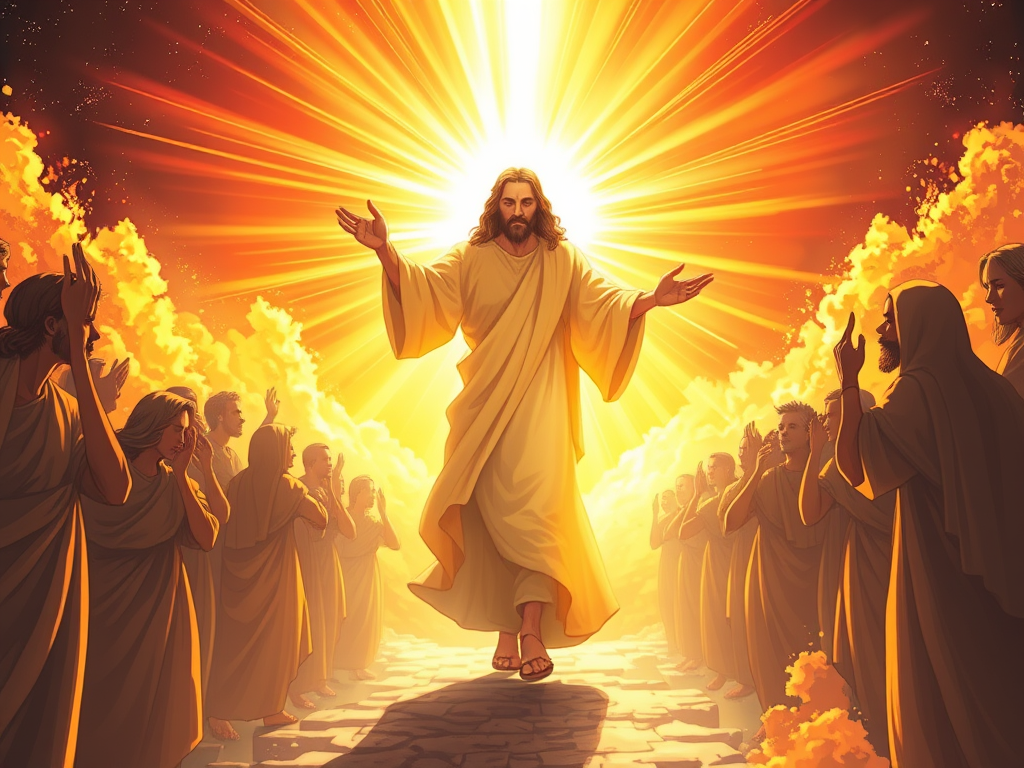
When Hebrews was written, many first-century Jewish Christians were wobbling in their faith. Facing pressure, persecution, and confusion, some no longer recognized the full deity and majesty of Christ.
The writer’s first mission, then, is crystal clear: lift their eyes back to Jesus.
And he does it by reminding them—right from the opening lines—of eight truths that set Jesus apart from every prophet, priest, angel, or spiritual figure in Israel’s history.
Let’s walk through these eight reminders together.
1. Jesus Is God’s Final and Perfect Prophetic Voice
The author begins by showing continuity—not contradiction—between the Old and New Testaments.
God did speak through Moses, Isaiah, Jeremiah, Ezekiel, and many others. But those messages were partial, preparatory, and incomplete.
Then Jesus came.
He didn’t just explain God’s glory like Ezekiel. He reflected it.
He didn’t just describe God’s holiness like Isaiah. He manifested it.
He didn’t just announce God’s power like Jeremiah. He displayed it.
In Jesus, God has spoken fully, decisively, and perfectly. No prophet—not even the greatest—can compete with the Son.
2. Jesus Is God’s Son
These struggling Jewish believers may have been tempted to see Jesus as just a teacher, a rabbi, a reformer, or a martyr. Hebrews confronts that gently but firmly.
Jesus is not simply a remarkable man—He is the Son of God.
This theme saturates the whole letter. His Sonship explains His authority, His mission, His obedience, His reign, and His perfection.
To deny the Son is to lose Christianity altogether.
3. Jesus Is God’s Appointed Heir
Hebrews says Jesus was appointed “heir of all things.”
This echoes Psalm 2: “Ask of me, and I will make the nations your inheritance.”
But the author goes further. Jesus does not simply inherit earth. He inherits the entire universe. And here’s the stunning part:The New Testament says we share in that inheritance with Him (Romans 8:17).
4. Jesus Is God’s Creative Agent
The writer quickly moves from Jesus’ future inheritance to His work in the beginning:
“Through Him God made the worlds.” (Hebrews 1:2)
Jesus didn’t appear in history as a mere Galilean teacher.
His hands shaped the galaxies.
His word summoned the stars.
His power ordered the cosmos.
A Christ who created the universe is the one who you and I are one in the spirit with.
5. Jesus Is the Radiance of God’s Glory
For Israel, God’s glory was visible—at Sinai, in the Tabernacle, in the Temple.
But Hebrews now points them to something greater:
Jesus is the radiance of God’s glory.
Not a reflection.
Not a symbol.
Not a metaphor.
The radiance.
Everything the glory of God ever represented—His presence, majesty, beauty, holiness—is seen perfectly in Jesus.
6. Jesus Is the Perfect Revelation of God’s Nature
Hebrews continues:
He is “the exact representation of God’s nature.”
The word (charaktēr) means an imprint—like a stamp pressed into metal.
Everything that God is, Jesus embodies in human form.
If you want to see God… look at Christ.
If you want to know God’s heart… look at Christ.
If you want to understand God’s character… look at Christ.
The unity and distinction between Father and Son are held perfectly in these phrases: radiance of His glory (oneness) and exact representation of His nature (distinctness).
7. Jesus Is the Cosmic Sustainer
Not only did Jesus create the universe— He upholds all things by His powerful word.
Every star stays in orbit because Jesus says so.
Every atom holds together because He wills it.
Every believer is secure because His word is effective.
This wasn’t abstract theology for the original readers.
It was comfort.
If Christ sustains the universe, He can sustain you. Their faith wouldn’t falter if they lifted their eyes to this cosmic Christ.
8. Jesus Is the Unique and Complete Sacrifice
Finally, the author turns from who Jesus is to what He did. On the cross, Jesus offered one sacrifice for all time.
No repetition needed.
No supplement required.
No human effort to complete it.
He did what no law and no priest could do.
When purification was accomplished,
Jesus sat down at the right hand of God.
Old Testament priests never sat because their work was never finished.
But Jesus sat because His work is finished forever.
His sacrifice is unrepeatable.
His salvation is complete.
His exaltation is final.
He is superior to angels, prophets, priests, and every spiritual being.
A Final Word
Hebrews begins by overwhelming us with Christ’s majesty—His voice, His Sonship, His inheritance, His power, His glory, His nature, His sustaining authority, and His finished work.
Why?
Because the only way to stand firm in adversity is to bow in awe before the supremacy of Christ. When we see Him as He truly is, and see us in Him, we will not drift. We will not shrink back. We will not turn away. We will worship.
References
Raymond Brown, The Message of Hebrews: Christ above All, The Bible Speaks Today (Leicester, England; Downers Grove, IL: InterVarsity Press, 1988), 27–35.


Leave a Reply