

Paul’s words in Romans 8 are not a casual reflection; they are a crescendo — the triumphant finale of one of the most glorious chapters in Scripture. Having described the life of the Spirit, the hope of glory, and the unbreakable chain of salvation (foreknown, predestined, called, justified, glorified), Paul pauses. Then, as if overwhelmed by the sheer magnitude of grace, he turns our attention to the implications of it all.
And he does it through four questions.
John Stott beautifully describes the moment:
“Paul hurls these questions out into space, as it were, defiantly, triumphantly, challenging any creature in heaven or earth or hell to answer them or to deny the truth that is contained in them.” (Romans, 103)
Each question reminds us who God is for us — our protector, provider, protagonist, and preserver.
1. God Is Your Sovereign Protector
“If God is for us, who can be against us?” (v.31)
Paul isn’t suggesting that we have no enemies. In verses 35–36 he lists them openly — tribulation, distress, persecution, famine, danger, and even death. But his point is clear: none of these adversaries carry any real weight in the presence of God’s sovereignty.
If the One who foreknew, predestined, called, justified, and glorified you is for you, then opposition is rendered powerless. No enemy can thwart the ultimate good God has purposed for you.
Even the things that seem to work against you — human hostility, spiritual warfare, personal failure — are, by the time grace has finished its work, working together for your good (v.28).
When God is for you, the equation changes completely. The believer’s confidence doesn’t come from the absence of opposition, but from the presence of divine favor.
2. God Is Your Supreme Provider
“He who did not spare His own Son, but delivered Him over for us all — how will He not also with Him freely give us all things?” (v.32)
Paul moves from protection to provision — and his reasoning is brilliant. He doesn’t simply ask, “Will God give us all things?” That question alone could lead us to doubt. Instead, Paul anchors it in history:
“He who did not spare His own Son…”
In other words, the greatest proof of God’s generosity has already been displayed. If God has given what is most precious — His own Son — then how could He withhold anything lesser?
As Cranfield observed:
“Since God has done the unspeakably great and costly thing, we may be fully confident that He will do what is by comparison far less.” (Romans, 436)
Our daily needs, our unseen prayers, our longings for peace and direction — all are met in the light of the cross.
The cross is not only the means of our salvation; it is the measure of God’s willingness to provide.
3. God Is Your Spiritual Protagonist
“Who will bring a charge against God’s elect? God is the one who justifies; who is the one who condemns?” (vv.33–34)
This question moves from the external world of enemies to the internal world of accusation.
Paul knows the inner life of believers — the conscience that condemns, the heart that fears, the voice that whispers, “You’ve failed too many times.”
He doesn’t deny that accusations will come. Satan, the “accuser of the brethren,” will bring them. People may judge. Our own hearts may tremble. But Paul declares such accusations powerless — not because we are sinless, but because our penalty has already been paid.
As J. I. Packer writes:
“Nobody is in a position to get God’s verdict reviewed!” (Knowing God, 248)
Christ has died, been raised, and now intercedes for us at the right hand of God. There is no higher court. The verdict has already been issued: Justified.
Even when the believer stumbles, the Judge who once declared them righteous now stands as their Advocate.
4. God Is Your Sustaining Preserver
“Who shall separate us from the love of Christ?” (vv.35–39)
This is the climax of Paul’s argument — the question of questions.
Paul lists every conceivable threat to our security:
- Tribulation or distress
- Persecution or famine
- Nakedness, danger, or sword
- Death or life
- Angels or principalities
- Things present or things to come
- Height or depth
- Any other created thing
Having endured most of these himself (see 2 Corinthians 11:26–27; 12:10), Paul writes not as a theorist but as a witness. He has tested the love of Christ through every trial — and found it unbreakable.
Nothing in heaven, earth, or hell can sever the bond forged by divine love.
Even death, which seems to end everything, only ushers us into the fuller presence of the One who loves us most (Phil. 1:21–23).
And what of sin? Could God Himself separate us from His love because of our failures? Paul has already answered: No.The very sins that trouble your conscience were nailed to the cross with Christ. The penalty is gone. The separation has already been closed.
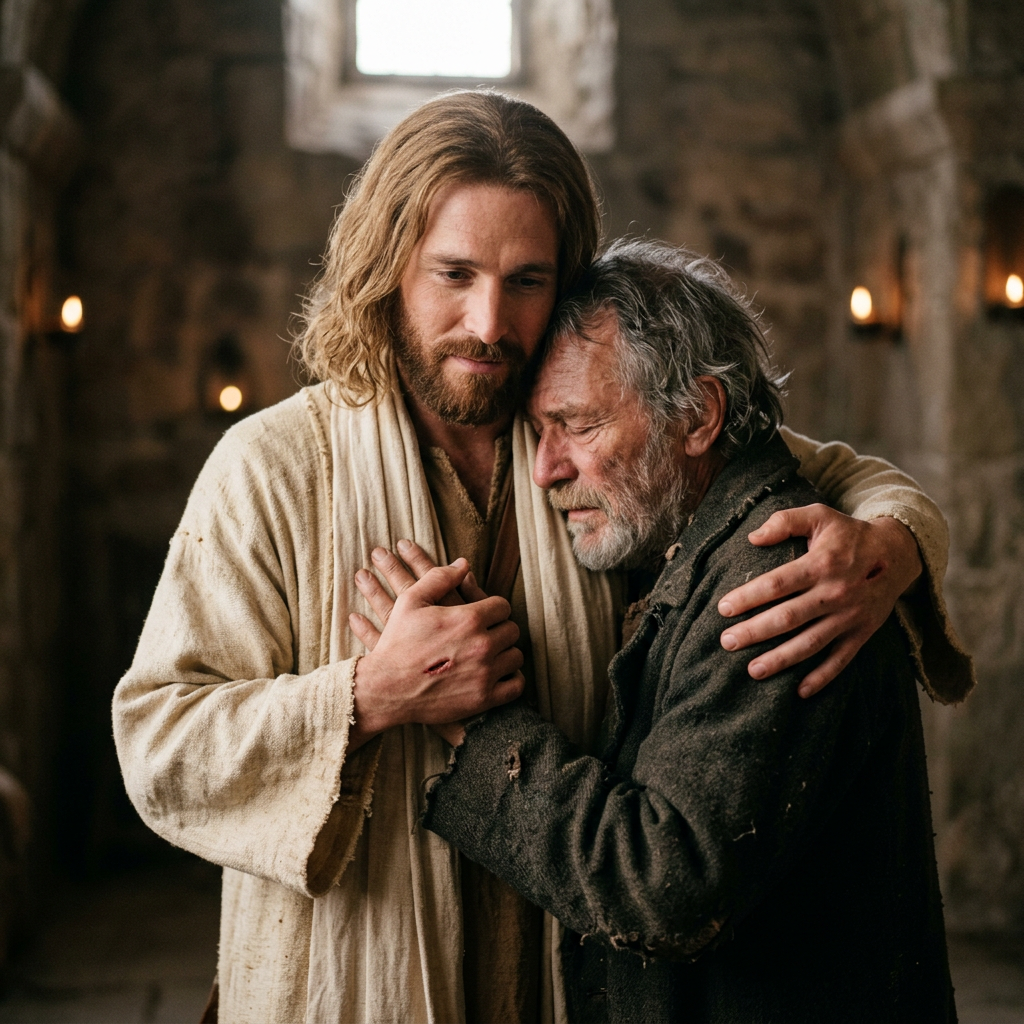
If God did not spare His own Son to gain you, He will not discard you now.
The Unbreakable Logic of Grace
Paul’s four questions build one upon another like the steps of a staircase ascending into assurance:
- If God is for us, who can be against us? — He protects us.
- How will He not freely give us all things? — He provides for us.
- Who can bring a charge against God’s elect? — He vindicates us. We are justified.
- Who shall separate us from the love of Christ? — He loves us.
Each question crushes fear. Each answer strengthens faith.
This is no shallow optimism — it is the invincible confidence of those who know the character of their God.
The cross is the proof that God is not only for us, but with us — from beginning to end.
Reflection
When doubt rises, remember the order of Paul’s argument:
- Rather than being against you, God is for you.
- Rather than withholding, He gives all things.
- Rather than condemning, He justified you.
- Rather than abandoning, He holds you fast in love.
Nothing — not your past, your failure, your fear, or your enemy — can undo what Christ has done.
The One who began the work will bring it to completion.
📚 Reference
Sam Storms, Biblical Studies: Romans (Edmond, OK: Sam Storms, 2016), Romans 8:31–39.
John Stott, The Message of Romans (InterVarsity Press, 1994).
C. E. B. Cranfield, A Critical and Exegetical Commentary on Romans (T&T Clark, 1975).
J. I. Packer, Knowing God (InterVarsity Press, 1973).
Douglas Moo, The Epistle to the Romans (Eerdmans, 1996).
Continue reading
Previous in the Romans series: When All Things Work Together
Next in the Romans series: Does Romans 9 Mean God Predestines Some to Damnation?
Related reading:


Leave a Reply