
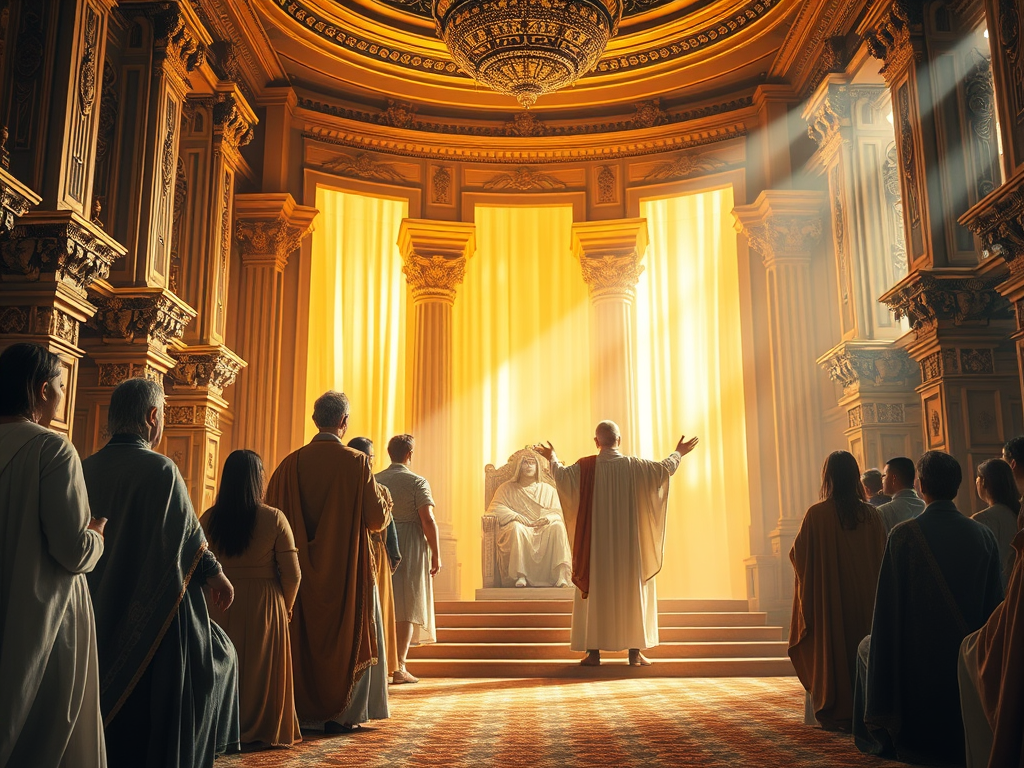
“Through Him also we have obtained our introduction by faith into this grace in which we stand, and we exult in the hope of the glory of God.”— Romans 5:2
Paul’s words in Romans 5:2 are rich with meaning. He tells us that through Christ, believers have been introduced into grace and now stand firmly in it. But what is the nature of this grace? How is it different from the old way of approaching God, and what does it mean for us today?
Introduced Into Grace
Paul uses the rare Greek word προσαγωγή (prosagōgē), which appears only here and in Ephesians 2:18 and 3:12. Literally it means “introduction” or “a bringing near.” In classical Greek it carried a courtly or diplomatic sense—the act of being formally presented to a king or high official.
That’s the picture Paul paints: believers are not barging into God’s throne room. We are formally introduced by Christ Himself. Our unfitness to enter is acknowledged, but the Son of God brings us in.
This is a radical shift from the Old Testament. In Exodus and Leviticus, approaching God was costly, fearful, and restricted to priests—especially the high priest, who could enter the Holy of Holies only once a year. But now, because of Christ, every believer has priestly access. We are invited to draw near with confidence (Hebrews 4:16; 10:19–22).
Grace is not a door we occasionally peek through—it is the palace in which we now dwell.
Standing Firm in Grace
Paul deepens this thought with two verbs in the perfect tense:
- ἐσχήκαμεν (eschēkamen) — “we have obtained [access/introduction].”
- A past completed act with continuing results. We were introduced into grace, and we still enjoy that privilege.
- ἑστήκαμεν (hestēkamen) — “we have stood/are standing.”
- Perfect tense of ἵστημι (histēmi), meaning “to stand firm, be established.” We were placed securely in grace and remain immovable.
Together these stress permanence. Our standing in grace is not temporary or fragile. It is continuous, secure, and settled.
As John Stott writes: “Our relationship with God, into which justification has brought us, is not sporadic but continuous, not precarious but secure.” (The Message of Romans, p.140).
Grace: Not Cheap, But Costly
Some dismiss this as “cheap hyper grace.” But nothing about grace is cheap. It is free to us, but it cost Christ His blood. The “grace in which we stand” is not fragile favor that comes and goes like human approval. It is God’s permanent welcome, secured at infinite cost.
Paul contrasts the Old Covenant with the New Covenant here:
- Old Covenant: access was rare, restricted, and precarious.
- New Covenant: access is constant, secure, and universal to all who believe.
It is not “a visit to the palace,” but living in the palace.
The Nature of This Grace
So what is the nature of the grace in which we stand?
- It is secure — grounded in Christ’s finished work, not our fluctuating performance.
- It is relational — we are not distant subjects awaiting an audience, but children in our Father’s house.
- It is abundant — grace is not rationed; it overflows (John 1:16–17).
- It is transformative — standing in grace shapes us into Christ’s likeness (2 Corinthians 3:18).
- It is enduring — nothing can separate us from God’s love (Romans 8:38–39).
Conclusion
Romans 5:2 reminds us that justification does not merely forgive us—it establishes us. We have been introduced by Christ into the throne room of grace, and we stand there permanently.
The nature of this grace is not fragile or fleeting. It is royal, priestly, abundant, secure, and everlasting. And because we stand in grace, we can rejoice with confident hope in the glory of God.
Continue reading
Previous in the Romans series: The Benefits of Justification
Next in the Romans series: Refined Through Fire
Related reading:


Leave a Reply