
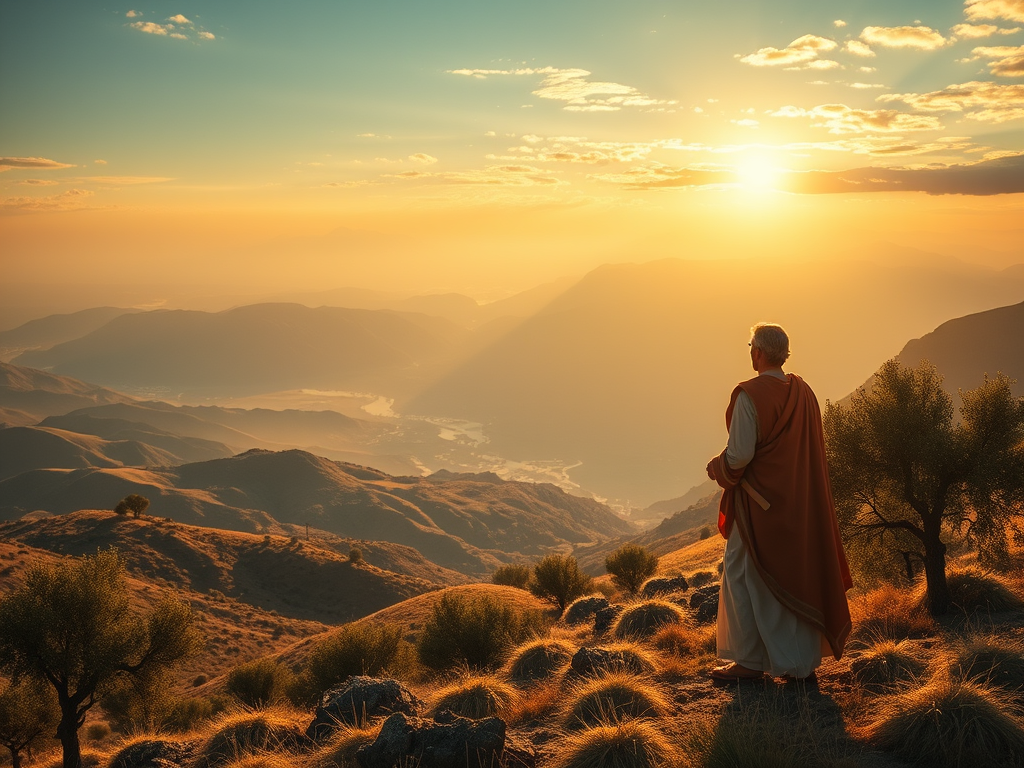
When God first called Abraham, He promised him a specific inheritance: “To your offspring I will give this land” (Gen. 12:7). That land was Canaan — a defined territory between the Nile and the Euphrates (Gen. 15:18). For Israel, the land was central: it meant God’s people, in God’s place, under God’s rule.
But in the New Testament, something surprising happens. Both Jesus and Paul expand this promise far beyond Canaan. The land becomes the whole world.
The Original Land Promise: Canaan
- Genesis 12:7; 15:18 — the promise of land to Abraham’s descendants.
- Israel’s story centers on entering, losing, and longing for this land.
- The land symbolized God’s presence and blessing.
But it was never meant to stay limited. The OT prophets already looked forward to something bigger — a renewed earth, a worldwide kingdom.
Jesus: The Meek Inherit the Earth
But Jesus shows what God really meant when he said, in the Sermon on the Mount:
“Blessed are the meek, for they shall inherit the earth” (Matt. 5:5).
Here’s what’s radical:
- Jesus quotes Psalm 37:11 — “the meek shall inherit the land.”
- In the original, “land” (ha’aretz) referred to Canaan.
- But Jesus universalizes it: in Greek, gē means the earth as a whole.
For Jesus, the inheritance of God’s people is no longer one strip of land in the Middle East. It’s the entire renewed earth.
It was not about a kingdom on earth, but about the kingdom of God led and ruled by believers through Christ, with the authority and power over the darkness, to bring about the justice of the gospel to the whole earth.
Paul: Heir of the World
Then Paul makes it clear in Romans 4:13:
“The promise to Abraham and his offspring that he would be heir of the world (kosmos) did not come through the law but through the righteousness of faith.”
Notice Paul doesn’t say Abraham would inherit “the land” (gē) but “the world” (kosmos). This is deliberate. Abraham’s promise wasn’t just Canaan — it was the whole created order, fulfilled in Christ, the true Seed (Gal. 3:16).
Prophetic Foundations
Jesus and Paul weren’t inventing something new. They were standing in the flow of the OT prophets:
- Isaiah 65:17; 66:22 — new heavens and new earth.
- Daniel 7:14, 27 — the Son of Man receives authority over all nations.
- Psalm 2:8 — the Messiah inherits the nations and the ends of the earth.
The trajectory was always moving from land → world, from Canaan → cosmos.
What It Means for the Church
For those in Christ, the land promise is not abolished but fulfilled on a cosmic scale:
- Inheritance: Not just Canaan, but the whole new creation (Matt. 5:5; Rev. 21–22).
- Identity: Abraham’s family is not limited to one nation but includes all who believe (Gal. 3:29).
- Hope: We don’t just “go to heaven.” We will reign with Christ in a renewed world (Rom. 8:17, 21).
The church is Abraham’s family, and the church’s inheritance is nothing less than the world made new.
Conclusion: One Promise, Fully Realized
The land promise wasn’t changed or canceled. It was expanded and fulfilled in Christ.
- Jesus: The meek inherit the earth (Matt. 5:5).
- Paul: Abraham is heir of the world (Rom. 4:13).
- Prophets: Anticipated a new heavens and new earth.
In other words: Canaan was the shadow. Christ and the new creation are the substance. And the church, united to Him, is the heir of it all.
References for Further Study
- N. T. Wright, Paul and the Faithfulness of God
- Richard Hays, Echoes of Scripture in the Letters of Paul
- Douglas Moo, Romans (NICNT)
- John Stott, The Message of the Sermon on the Mount
Continue reading
Previous in the Romans series: How the Promises to Abraham Are Fulfilled in the Church
Next in the Romans series: The Guarantee of the Promise
Related reading:


Leave a Reply