
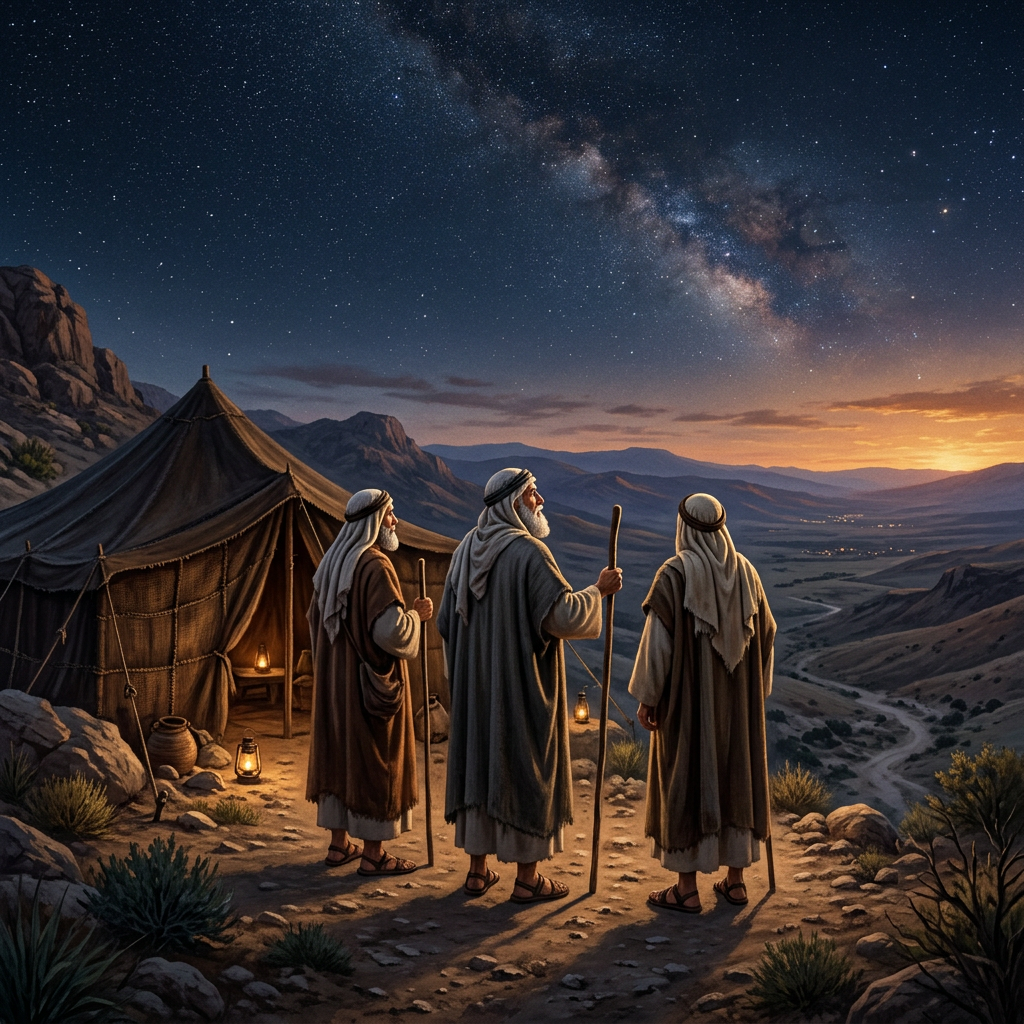
“By faith Isaac blessed Jacob and Esau, even regarding things to come. By faith Jacob, as he was dying, blessed each of the sons of Joseph, and worshiped, leaning on the top of his staff. By faith Joseph, when he was dying, made mention of the exodus of the sons of Israel, and gave orders concerning his bones.”— Hebrews 11:20–22
When we think of the great examples of faith in Hebrews 11, we naturally tend to notice the dramatic ones. Noah built an ark when there was no flood. Abraham left his country without knowing where he was going. Sarah believed God concerning a child when she was beyond the age of bearing children. Abraham was later willing to offer Isaac because he had become so persuaded of God’s promise that he reasoned God could raise Isaac from the dead.
Then we come to verses 20–22, and the pace seems to slow down. Isaac blesses his sons. Jacob blesses his grandsons. Joseph talks about what should happen to his bones after he dies.
Yet all three are included among the great examples of faith, and there is something they have in common. They were approaching the end of their lives while God’s promise was still largely ahead of them.
God had promised Abraham a nation and a land. Isaac lived and died without seeing the nation that would eventually come from him. Jacob went down into Egypt rather than settling permanently in the land promised to his family. Joseph became enormously successful in Egypt and died there. If they had judged God’s faithfulness only by what they had personally lived to see, there would have been plenty of room for questions.
Instead, their final actions show that they expected God to continue His work after they were gone.
Isaac Blessed His Sons Concerning Things to Come
Hebrews begins with Isaac:
“By faith Isaac blessed Jacob and Esau, even regarding things to come.”
The story behind this verse in Genesis 27 is not particularly tidy. There was favoritism in Isaac’s family, deception by Jacob and Rebekah, anger from Esau, and consequences that would follow for years. Hebrews does not pretend that these people had flawless lives. In fact, one of the encouraging features of Hebrews 11 is how familiar the writer is with their failures and yet how willing he is to speak about their faith.
What mattered here was that Isaac believed the promise of God would continue into another generation. His blessing was about “things to come.” He would not personally see most of those things, but that did not make them less certain to him.
This is worth remembering when we think about faith. We sometimes associate faith almost exclusively with receiving something from God during our lifetime. We believe for a particular outcome, pray about it, and naturally hope to see it happen. There is nothing wrong with believing God and acting in faith. Hebrews 11 itself is filled with people who acted because they trusted Him. But these verses broaden the picture. Faith can also trust God with a future that extends beyond our own involvement.
Isaac could die without seeing the completed promise because the promise did not depend upon Isaac remaining alive to supervise its fulfillment.
Jacob Had Learned Something About God
Jacob’s example is particularly moving:
“By faith Jacob, as he was dying, blessed each of the sons of Joseph, and worshiped, leaning on the top of his staff.”
By this point Jacob was an old man, and his life had taken turns he could hardly have anticipated when he was younger. He had deceived his brother and father, fled from home, been deceived by Laban, worked for years to build his household, wrestled with God, mourned Joseph as though he were dead, and eventually discovered that the son he had grieved for was alive and governing Egypt.
Jacob had spent much of his life trying to manage circumstances. Near the end, however, Hebrews gives us the picture of a weak old man leaning on his staff and worshiping God.
Genesis 48 tells us that Joseph brought Ephraim and Manasseh to Jacob so that he could bless them. Joseph expected Jacob to place his right hand upon Manasseh because Manasseh was the firstborn. Jacob deliberately crossed his hands and gave the greater blessing to Ephraim.
Joseph thought his father had made a mistake and tried to correct him, but Jacob knew exactly what he was doing.
There is an interesting thread running through these generations. Human expectations repeatedly suggested that one person should receive the prominent place, while God’s purpose unfolded differently. Ishmael was Abraham’s firstborn, yet the promise came through Isaac. Esau was older than Jacob, yet the covenant line continued through Jacob. Manasseh was older than Ephraim, yet Jacob placed Ephraim before him.
This does not give us a formula for predicting whom God will choose or how every circumstance will turn out. It does, however, remind us that God’s purposes are not governed by the systems of human merit and rank that come so naturally to us.
That becomes especially meaningful when we come to the gospel. Our standing with God does not rest upon where we rank compared with somebody else. We did not become righteous because we performed better than our neighbour, and we do not remain accepted because our Christian life has been more impressive than someone else’s. In Christ, righteousness is given to us as a gift.
The finished work leaves no room for boasting. Jesus accomplished what we could never accomplish for ourselves, and we receive what He has done by faith.
Perhaps Jacob understood more about grace at the end of his life than he did at the beginning. The young Jacob spent considerable energy grasping for blessing. The old Jacob was worshiping while giving it away.
Joseph Wanted His Bones Taken Out of Egypt
Joseph’s example may be the most striking of the three.
“By faith Joseph, when he was dying, made mention of the exodus of the sons of Israel, and gave orders concerning his bones.”
Joseph had spent most of his life in Egypt. He had gone there as a slave, but God had brought him through extraordinary circumstances until he became one of the most powerful men in the country. Egypt was where Joseph married, raised his children, exercised authority and saved his family during the famine.
If anyone in Jacob’s family had reason to become attached to Egypt, it was Joseph.
Yet when he was dying, his thoughts went back to God’s promise.
Genesis records his words:
“I am about to die, but God will surely take care of you and bring you up from this land to the land which He promised on oath to Abraham, to Isaac, and to Jacob.”— Genesis 50:24
Then he made the Israelites swear that when this happened, they would carry his bones with them.
Joseph had no timetable for the exodus. He would never meet Moses. He would not watch the plagues fall upon Egypt or walk through the Red Sea. In fact, generations would pass before any of those events happened.
Still, Joseph arranged his own burial around the promise of God.
His coffin in Egypt became a quiet witness to what he believed. Egypt might be where his body rested for the moment, but Joseph did not regard Egypt as the final destination of God’s people.
Many years later, when Israel finally left, Exodus specifically mentions that Moses took Joseph’s bones with him. Eventually Joshua records that they were buried at Shechem in the land of promise.
Joseph had been dead for centuries by then, but God had not forgotten what He had promised.
Faith Does Not Need to See Everything Finished
There is something very freeing in these three verses. Isaac, Jacob and Joseph all reached the end of their lives with parts of God’s promise still unresolved. Hebrews nevertheless describes them as people of faith.
Sometimes we unconsciously think that a life of faith should eventually produce a neat ending in which everything makes sense. Every prayer gets an observable answer, every difficult season receives an explanation, and everything God has been doing becomes clear before our story ends.
These men did not have that experience.
They knew enough about God to entrust the unfinished parts to Him.
That is different from passivity. Isaac spoke over his sons because he believed something about their future. Jacob deliberately blessed Ephraim and Manasseh. Joseph gave very specific instructions concerning his remains. Their faith affected what they did, even though the ultimate fulfillment belonged to God.
There are things we can actively trust God for today. Faith can lead us to attempt something difficult, take a step we would otherwise be afraid to take, pray boldly, give generously, or move forward when circumstances seem unpromising. Nothing about grace requires us to become passive people.
At the same time, biblical faith is not a guarantee that every outcome we personally desire will occur. The confidence of Hebrews 11 is ultimately confidence in God and in what He has said. Isaac, Jacob and Joseph were not inventing promises for themselves. They were responding to the God who had revealed Himself to them.
We Have Seen More Than They Did
There is another reason these verses should encourage us as new-covenant believers. These men died looking forward to promises whose fulfillment they had not yet seen. We also look forward, but we do so from the other side of the cross.
God promised redemption, and Christ came.
Jesus offered Himself once for all. Sin has been dealt with, the new covenant has been established in His blood, and Christ has risen from the dead. Our acceptance before God is therefore not one of the unfinished questions of the Christian life. We are not waiting to discover whether the sacrifice of Jesus was sufficient or whether God will finally accept us if we remain faithful enough.
Hebrews has already answered those questions.
“For by one offering He has perfected for all time those who are sanctified.”— Hebrews 10:14
Our confidence about the future grows out of something God has already accomplished in the past.
There are still many things we do not see. We await the resurrection of our bodies and the full renewal God has promised. On a personal level, we also live with ordinary uncertainties about our families, work, health, plans and the people we love. Faith does not give us advance knowledge of how every one of those stories will unfold.
What it gives us is Someone trustworthy in the middle of them.
Isaac could bless his sons concerning things to come. Jacob could worship at the end of a complicated life. Joseph could die in Egypt while insisting that his bones would one day leave Egypt.
They had learned that God’s faithfulness was not limited to what they could see during their own lifetime.
We know that even more clearly because we have seen where the promise ultimately led.
It led to Christ.
And when we look at His cross and His empty tomb, we have good reason to trust God with everything that, from where we stand today, still looks unfinished.
Continue reading
Previous in the Hebrews series: Abraham Believed God Had No Constraints
Next in the Hebrews series: What Was the Faith of Moses?
Related reading:

Leave a Reply