
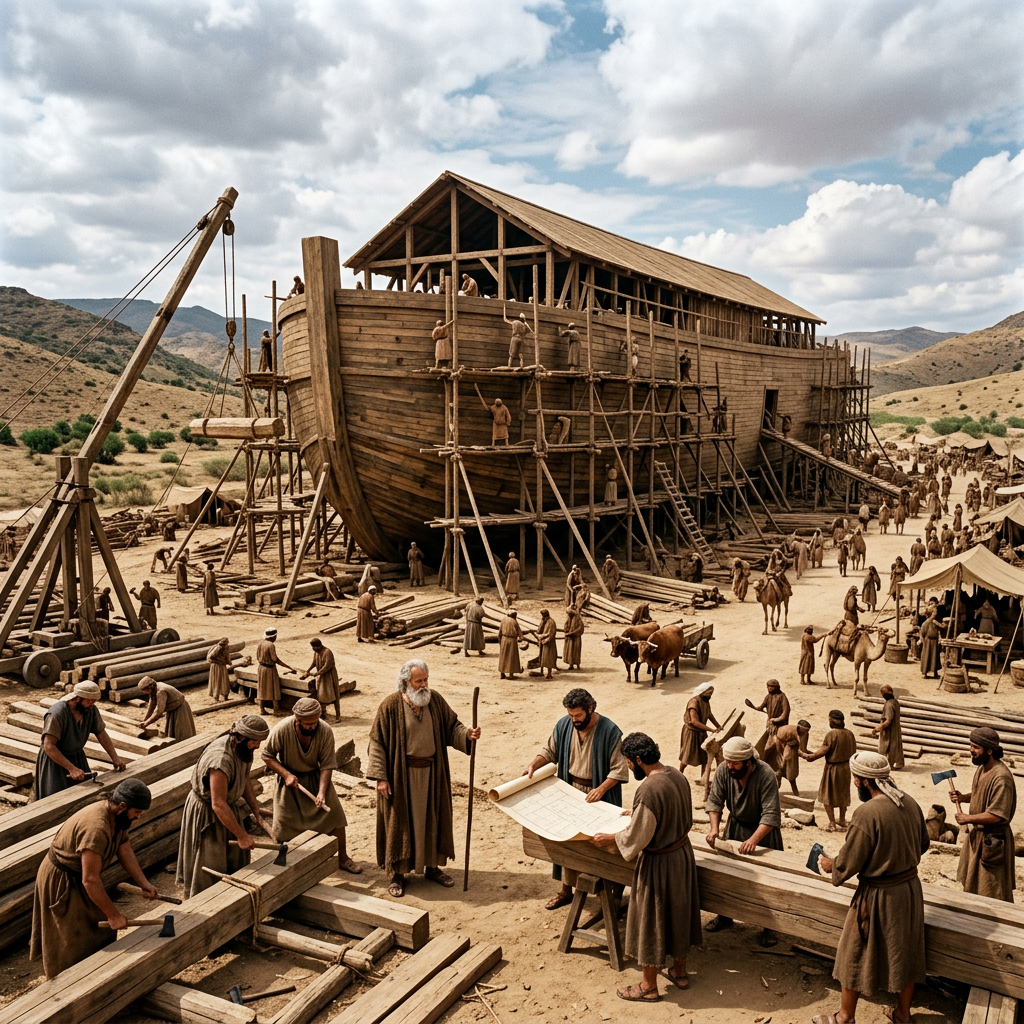
“By faith Noah, being warned by God about things not yet seen, in reverence prepared an ark for the salvation of his household, by which he condemned the world and became an heir of the righteousness which is according to faith.” — Hebrews 11:7
The progression in Hebrews 11 is beautiful.
The author says faith believes God’s testimony about creation. Then he says faith worships God, as Abel did. Then, faith walks with God, as Enoch did.
Now the writer introduces Noah and shows us another dimension of faith.
Faith obeys before it understands everything.
Noah’s story is about trusting God’s word long before anyone else could see what God had promised.
“Warned by God About Things Not Yet Seen”
The writer begins with an important detail.
Noah was warned by God about something that had never happened before.
The sky looked ordinary and life continued as usual. Nothing around Noah suggested that the world was about to change.
Yet God spoke.
That became enough for Noah.
Notice how this connects with every person we have already met in Hebrews 11.
Abel trusted what God had revealed.
Enoch walked with the God he could not see.
Noah believed God’s warning about an event that no one else could yet observe.
Faith consistently begins the same way.
God speaks, and faith responds.
Faith Often Lives Ahead of Sight
Noah did not begin building the ark because he saw rain clouds.
He built because he believed the One who had spoken. That is one of the defining characteristics of biblical faith.
Faith does not wait until everything becomes obvious. It acts because God’s word has become more certain than present circumstances.
Imagine how strange Noah must have appeared. Day after day he continued building.
Neighbors would have walked past.
Questions would have been asked.
Mockery probably followed.
Years passed.
Still no flood.
Still no visible evidence that Noah had heard correctly.
From the outside, it must have looked foolish.
From heaven’s perspective, it was faith.
“In Reverence”
Many English translations use the word reverence or godly fear.
The Greek word is εὐλαβηθεὶς (eulabētheis), which carries the idea of reverent caution, careful respect, or holy regard.
This was not panic.
Neither was it terror.
Noah’s response flowed from taking God seriously. When God spoke, Noah did not treat His words casually. He believed that God’s warning deserved a response.
There is a healthy reverence that faith produces. Not the fear of punishment, but the respect that says, “If God has spoken, I want my life to align with what He has said.”
Faith Builds
One of the most practical things Noah teaches us is that faith does something.
Not to earn God’s approval. Not to persuade God to act.
But because genuine trust naturally expresses itself.
James would later write that faith without works is dead. If Noah had simply said,
“I believe God,”
and never picked up a piece of wood, something would have been missing.
His actions did not create his faith, but rather revealed it. The ark became visible evidence of an invisible confidence.
“For the Salvation of His Household”
The ark was not merely an engineering project.
It became the means through which Noah’s family was preserved.
Notice the tenderness of the verse.
Noah’s faith was not only personal.
It became a blessing to those around him.
Throughout Scripture, faith often has that kind of influence.
A parent’s trust in God shapes a family.
A faithful husband or wife brings stability into a home.
A believer’s quiet confidence strengthens friends during difficult seasons.
Each person must ultimately respond to God personally.
Yet one person’s faith can create an environment where others experience God’s goodness.
“He Condemned the World”
This phrase can sound harsh.
Did Noah spend decades preaching condemnation?
That is not what Hebrews says.
The world was condemned because Noah’s obedience stood as a contrast to its unbelief.
The Greek word κατέκρινεν (katekrinen) means “condemned” or “passed judgment.”
His life itself became the testimony.
Imagine two people hearing the same warning.
One believes it.
One ignores it.
When the warning proves true, the believer’s response exposes the unbelief of the other.
Noah did not need to pronounce judgment.
His obedience became the evidence that God’s word had been trustworthy all along.
The same principle appears throughout Scripture.
Light exposes darkness simply by existing.
“He Became an Heir of the Righteousness That Is According to Faith”
This statement sounds remarkably familiar.
The writer is preparing us for Abraham, who will soon become the great example of righteousness by faith.
Noah did not become righteous because he built an ark.
He became an heir of the righteousness that comes through faith.
The ark was not the source of his righteousness.
Faith was.
The same truth echoes throughout the New Testament.
Our standing before God has never rested on what our hands accomplish.
It rests on trusting what God has provided.
That is why Paul can say Abraham believed God and it was counted to him as righteousness. It was already visible in Noah.
Noah and the Finished Work of Christ
There is another beautiful connection.
Noah entered the ark before the flood came.
Once inside, his safety depended not on his ability to survive the waters but on the ark that carried him through them.
For Christians, the ark becomes a wonderful picture of Christ.
Our confidence is not in our ability to withstand God’s judgment.
Our confidence is in the One who has already borne it for us.
Noah was safe because he was in the ark.
Believers are safe because they are in Christ.
The security was not found in Noah’s strength.
It was found in what God had provided.
Faith Builds Before It Sees
Most of us will never build an ark.
But we will all face moments when God asks us to trust Him before we can see the outcome.
Sometimes forgiveness comes before reconciliation.
Sometimes generosity arrives before provision is clear.
Sometimes obedience precedes understanding.
Sometimes peace comes before circumstances change.
Faith is not pretending the future is visible.
Faith is trusting the God who already sees it.
Noah spent years building something that probably made little sense to everyone around him.
In the end, it wasn’t Noah who looked foolish.
It was the people who ignored the voice of God.
Hebrews includes Noah because his life reminds us that faith often looks ordinary while it is being lived.
It may involve years of quiet obedience with little visible reward.
Yet every act of trust declares something profound:
God’s word is more reliable than what my eyes can presently see.
That is the kind of faith that the writer of Hebrews invites every believer to embrace.
Continue reading
Previous in the Hebrews series: Enoch, and When Faith Looks Ordinary
Next in the Hebrews series: When God Calls You Without Giving You the Map
Related reading:


Leave a Reply