
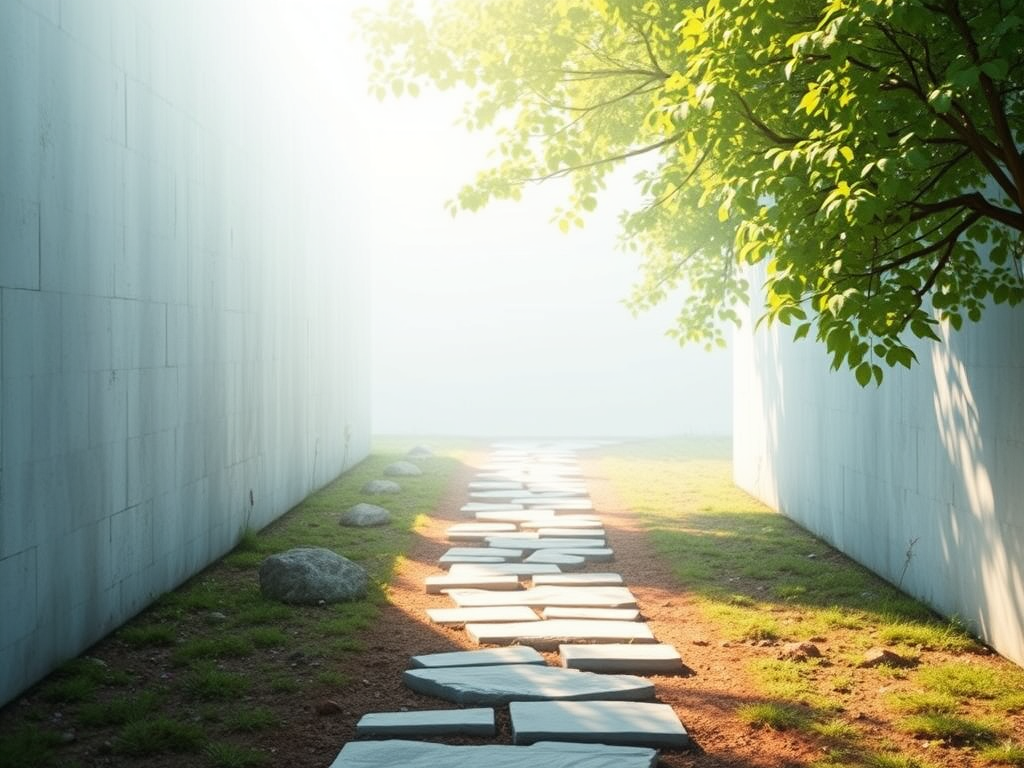
I came across a model in The Critical Journey by Janet Hagberg and Robert Guelich, which Peter Scazzero also references in Emotionally Healthy Spirituality. And honestly, it explains so much about the Christian life—not from a legalistic perspective, but from a deeply human and spiritual one.
They describe six stages in our journey with Christ.
Each stage builds on the last, just like a child grows into a teen and a teen into an adult.
But here’s the important part:
You can’t jump stages.
And you can get stuck.
Spiritually, you may be born again (stage one), yet be stuck emotionally in fear, legalism, striving, or performance. Or you may be outwardly mature but inwardly exhausted.
And that’s where “the Wall” comes in.
When We Hit the Wall
Scazzero says you can stagnate at a stage—not because you’re rebellious, but because you refuse to trust God into the unknown. When we turn inward in fear instead of faith, the soil of our heart slowly hardens.
Jesus described this in the parable of the sower (Mark 4:1–20).
Your heart becomes resistant—not unsaved, just unresponsive.
And ironically, this often happens after years of serving God.
Before I explain the stages, let me say this:
- You may identify with more than one stage at once. I know I do.
- You can be in transition between stages.
- But you will always have a “home stage”—a place where your soul lives right now.
And as I look back, I see exactly how these stages played out in my life.
Stage 1: Life-Changing Awareness of God
This is when you first encounter Jesus.
Everything is new, fresh, alive, joyful.
You are:
- hungry for God
- aware of His presence
- sensitive to His love
- amazed at His mercy
This was me around 2011. I couldn’t get enough of God. I would pray for hours every night. I felt His presence so strongly that it felt addictive. When I didn’t feel Him, I panicked: “What happened? Did I lose Him?”
My spirituality ran on feelings, passion, and spiritual highs.
Beautiful, but fragile.
Stage 2: Discipleship
This stage is about learning what it means to follow Jesus.
It’s when you:
- learn the Bible
- join a community
- build spiritual disciplines
- grow in knowledge
- grow in consistency
For me, this began in 2014 when I moved to Italy. I met amazing pastors. One of them—Pastor Steve Gray—shaped my life so deeply. He taught me SOAP devotions, discipline, reading Scripture daily, structuring my life around truth rather than emotions.
I grew.
I matured.
I became disciplined.
I did Bible school.
I led worship.
I studied hard.
I grew fast.
And then came the next stage.
Stage 3: The Active Life
This is the doing stage.
You want to serve.
You want to minister.
You want to pour out.
You want to help everyone.
You want to use your gifts.
That was me.
I became:
- a worship leader
- a teacher
- an elder
- a preacher
- a mentor
- a leader
And with my natural tendency toward performance, I did more and more and more.
I equated activity with spirituality.
The more I did, the more I felt connected with God.
The less I did, the more guilty I felt.
I was newly married. I had a child. My family needed me. But inside, I was obsessed with doing “just a little more” for God.
And then… everything collapsed.
The Wall (Between Stage 3 and Stage 4)
Every believer eventually hits a Wall. Sometimes it’s between 2 and 3 or maybe 1 and 2. I hit over here.
What’s a wall? – A Wall is painful, unexpected, disorienting, and full of pressure — and yes, the Wall can come through the enemy’s attacks, circumstances, or even other people’s failures.
I will not pretend my Wall was pleasant or holy.
It wasn’t.
It came through spiritual attack, betrayal, misunderstanding, offense, and a painful church situation.
It absolutely left scars.
But here is the part that reflects the New Covenant reality:
What the enemy meant to break me, God used to transform me.
He didn’t cause the Wall — He used it.
That’s the pattern of Scripture:
- Joseph: “You meant it for evil, but God meant it for good.” (Gen. 50:20)
- Paul: “The things that happened to me advanced the gospel.” (Phil. 1:12)
- Peter: “After you have suffered a while… He will establish, strengthen, and settle you.” (1 Pet. 5:10)
And that’s exactly what happened to me.
My Wall came in 2023.
A scandal broke out in church, involving immorality. We handled it biblically — and because of that, many people turned against us. People we had poured into walked away. People we had served abandoned us.
The enemy used it to attack my:
- identity
- confidence
- calling
- relationships
- emotional stability
It resulted in:
- rejection
- offense
- isolation
- guilt
- overthinking
- emotional exhaustion
I cried privately.
I replayed conversations.
I questioned myself.
I tried to please people.
I blamed myself for things I couldn’t control.
That Wall was dark.
It was painful.
It was spiritual warfare.
But in that same place, God met me.
He used the Wall to pull out things that were buried:
- performance
- people pleasing
- fear of failure
- insecurity
- misplaced identity
- the pressure to “be enough”
The Wall didn’t come from God,
but the transformation certainly did.
And slowly — beautifully — God used what the enemy meant for harm to:
- break my false identities
- free me from validation addiction
- heal my inner life
- teach me rest
- anchor me deeper in Christ
- bring clarity to my calling
- rebuild my heart from the inside out
The Wall was an attack.
But the outcome was grace.
And this is why the Wall becomes the doorway into Stage 4 — the inward journey — where the Spirit finally deals with the roots, not just the branches.
Stage 4: The Journey Inward
This stage reveals the heart behind everything you’ve ever done—and everything you’ve ever avoided.
It’s painful.
It’s humbling.
It’s confusing.
But it’s transformative.
For me, this began right after that wall in 2023. I stopped serving in leadership. I stopped doing. I stopped performing. I was confused and broken.
I started blogging through the book of Philippians, and God showed me:
- my identity can’t be in ministry
- my validation can’t come from people
- my value doesn’t come from serving
- my worth isn’t in my performance
- my strength doesn’t come from myself
- my security cannot come from accomplishments
Paul said everything he accomplished was “loss compared to knowing Christ” (Phil. 3:7–10). And for the first time in 15 years, I actually felt that.
God didn’t want me to impress Him.
He wanted me to know Him.
This is also when I understood what Paul meant by “weakness”—it wasn’t sickness; it was the inability to control situations like persecution, rejection, abandonment. And in that weakness, Jesus said:
“My grace is sufficient for you.”
Weakness is not sin.
Weakness is surrender.
Weakness is rest.
And slowly, God healed me from:
- people pleasing
- performance pressure
- ministry guilt
- emotional exhaustion
- misplaced identity
This stage is not fast.
Not glamorous.
Not Instagram-friendly.
But it is beautiful.
Stage 5: The Journey Outward (From a New Center)
After the Wall and the inward journey, you begin to do outward things again, and I am part of this journey while working on Stage 1, 2,3 and 4 simultaneously.
But now:
- you serve from rest
- you give from love
- you minister from identity
- you help from overflow
- you do without striving
You’re not trying to earn anything.
You’re rooted.
This is where I feel I am today—slowly stepping outward again, but with a new anchor:
Christ is my center, not my performance.
I still have Stage 2 moments where I need discipline.
I still have Stage 3 impulses where I want to overdo.
But Stage 4 has forever changed my approach.
And that’s spiritual growth.
Not linear.
But real.
Stage 6: Transformed Into Love
This is the goal.
Not activity.
Not performance.
Not titles.
Not ministry positions.
Love.
God is love (1 John 4:8), and the more we grow, the more we become like Him—not by trying harder, but by renewing our mind to who we already are.
You don’t “learn” love.
You discover that the Spirit already poured it into your heart (Rom. 5:5).
You simply live out what’s in you.
This is maturity.
This is transformation.
This is Christ formed in you.
We Don’t Control Seasons—Or Walls
Walls will come.
Stages will shift.
Life will happen.
Seasons will change.
But through every season, every stage, every Wall…
Jesus remains the same.
And He is forming Christ in you, layer by layer, stage by stage, season by season.
Not through your striving.
But through His grace.
Continue reading
Related reading:
One response to “The Six Stages of Spiritual Growth Feat. My Journey”
-
Love this breakdown of the various stages, can see so much of my life in these steps



Leave a Reply