
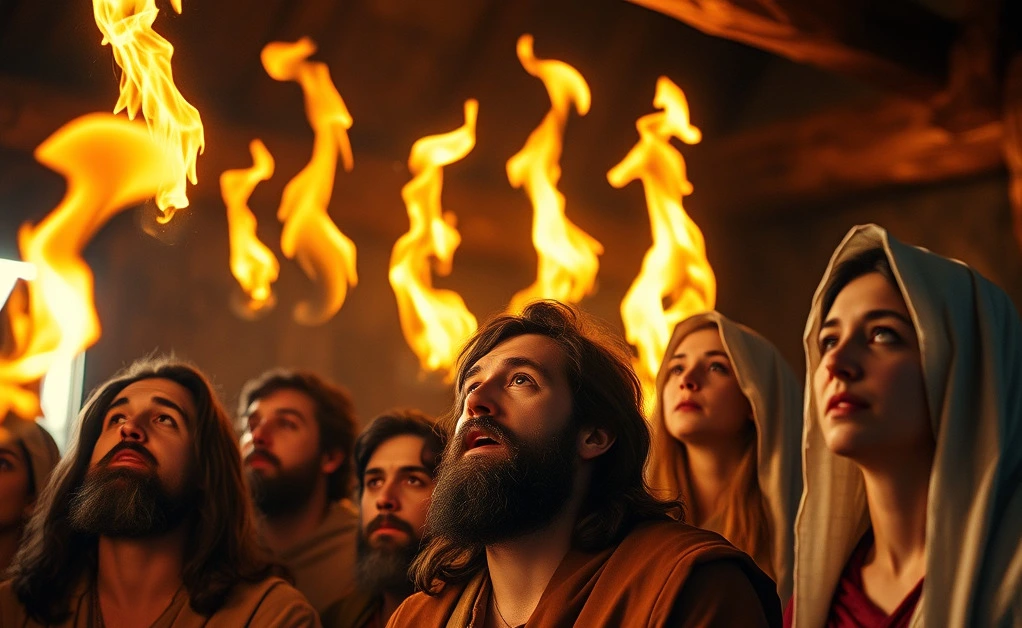
If you’ve been around church long enough, you’ve probably heard different takes on baptism in the Holy Spirit. Some say it happens at the moment you’re saved. Others say it’s a “second blessing” that comes later, usually with tongues as proof. And then there are those who say, “Well… it’s both!”
So which one’s right? Let’s walk through the main views, what the Bible says, and where I think the evidence points.
1. The Pentecostal View: Two Experiences
This is the classic Pentecostal teaching. It goes like this:
- At salvation, the Spirit comes to live in you and makes you a new creation.
- At Spirit baptism (later, separate, and distinct), the Spirit comes upon you in power to equip you for ministry and mission.
And usually, Pentecostals will add: the initial physical evidence of this baptism is speaking in tongues.
Their Biblical Case
- Acts 2 (Pentecost): The disciples already knew Jesus. He even breathed on them and said “Receive the Spirit” (John 20:22). But then in Acts 2, the Spirit falls in power, and they speak in tongues.
- Acts 8 (Samaria): The Samaritans believe and are baptized in Jesus’ name, but they only receive the Spirit later when Peter and John pray for them.
- Acts 10 (Cornelius): Gentiles believe the gospel, and then the Spirit falls, with tongues as confirmation.
- Acts 19 (Ephesus): Some disciples believe, but only after Paul lays hands on them do they receive the Spirit, with tongues and prophecy.
So Pentecostals say: “See? Salvation and Spirit baptism aren’t always the same moment.”
The Strengths
- It takes Acts seriously, not just as history but as a model.
- It puts fire back into the Christian life. There’s a hunger for more, not just a flat line after conversion.
- It explains why so many believers testify to powerful post-conversion experiences.
The Weaknesses
- Paul never talks about a second Spirit baptism.
- If not everyone speaks in tongues (1 Cor 12:30), then tongues can’t be required for Spirit baptism.
- Romans 8:9 is clear: if you don’t have the Spirit, you’re not even in Christ. That makes it hard to argue some believers have Christ but not the Spirit.
2. The Evangelical View: One Baptism at Conversion
Most Reformed and evangelical churches take the opposite stance. They’ll say:
- Spirit baptism happens once and for all, at conversion.
- You don’t need to go hunting for a second experience — you already have the Spirit in full.
Their Biblical Case
- 1 Corinthians 12:13: “For in one Spirit we were all baptized into one body.” Not some, but all.
- Romans 8:9: “Anyone who does not have the Spirit of Christ does not belong to him.” In other words, if you’re a Christian, you have the Spirit. Period.
- Galatians 3:2: Paul asks, “Did you receive the Spirit by works of the law, or by hearing with faith?” Clearly, the Spirit comes through faith, not later.
The Strengths
- Paul’s letters back this up very strongly. He assumes every believer already has the Spirit.
- It avoids creating a two-class Christianity (those with the Spirit and those without).
- It keeps the focus on Jesus, not on chasing experiences.
The Weaknesses
- It struggles with the “gaps” in Acts (like Samaria in Acts 8).
- It can feel flat. If Spirit baptism = conversion, then what about those undeniable, powerful “extra” moments believers experience?
- It risks turning the Spirit into just a doctrine on paper, not a living reality.
3. The Integrative View: One Baptism, Many Fillings
Here’s where a lot of modern theologians land (including N. T. Wright, John Piper, and Sam Storms, though they nuance it differently).
This view says:
- Spirit baptism = conversion. That’s when you are joined to Christ and His body. Without the Spirit, you’re not in Christ (Rom 8:9).
- Spirit fillings = ongoing empowerments. The Spirit doesn’t just come once and leave you to coast. He fills you again and again for boldness, holiness, prayer, and mission.
Their Biblical Case
- Conversion:
- 1 Cor 12:13 – All believers baptized in one Spirit into Christ’s body.
- Rom 8:9 – You cannot be in Christ without the Spirit.
- Ongoing Fillings:
- Eph 5:18 – “Be filled with the Spirit.” In Greek it’s continuous: “Keep on being filled.”
- Acts 4:31 – The same disciples who were filled at Pentecost are filled again, and they preach boldly.
- 2 Tim 1:6 – Paul urges Timothy to “fan into flame” the Spirit’s gift.
The Strengths
- It fits Paul’s teaching (Spirit at conversion) and Luke’s narrative (Spirit empowerment later).
- It allows for both: you already have the Spirit, but you can also experience more of His power.
- It avoids the “two-tier” Christianity of Pentecostalism and the “flat” Christianity of strict Evangelicalism.
The Weaknesses
- It’s less neat and tidy. There’s no formula like “get saved → get tongues → you’re done.”
- It leaves room for mystery, which some folks don’t like.
4. So What Did Paul Actually Teach?
Paul never talks about Spirit baptism as a second experience. For him:
- Spirit baptism happens when you’re saved — that’s when you’re united to Christ (1 Cor 12:13).
- Every believer has the Spirit (Rom 8:9).
- But Paul does talk about being filled again and again (Eph 5:18).
So, biblically speaking:
- There is no “Christian without the Spirit.”
- But there are plenty of Christians who need to be freshly filled with the Spirit’s power.
Final Thoughts
So, is Spirit baptism a second experience?
- If you’re Pentecostal, you’ll probably say yes.
- If you’re Reformed, you’ll probably say no.
- But if you want to put all the biblical pieces together, the integrative view makes the most sense:
- One baptism at conversion.
- Many fillings for empowerment.
The real question isn’t, “Have I had the second blessing?” The real question is: Am I daily walking in the Spirit’s fullness?
As Paul says:
“Be filled with the Spirit … giving thanks always and for everything to God the Father in the name of our Lord Jesus Christ.” (Eph 5:18, 20)
That’s not about chasing an experience — that’s about living in constant dependence on the Spirit.


Leave a Reply