
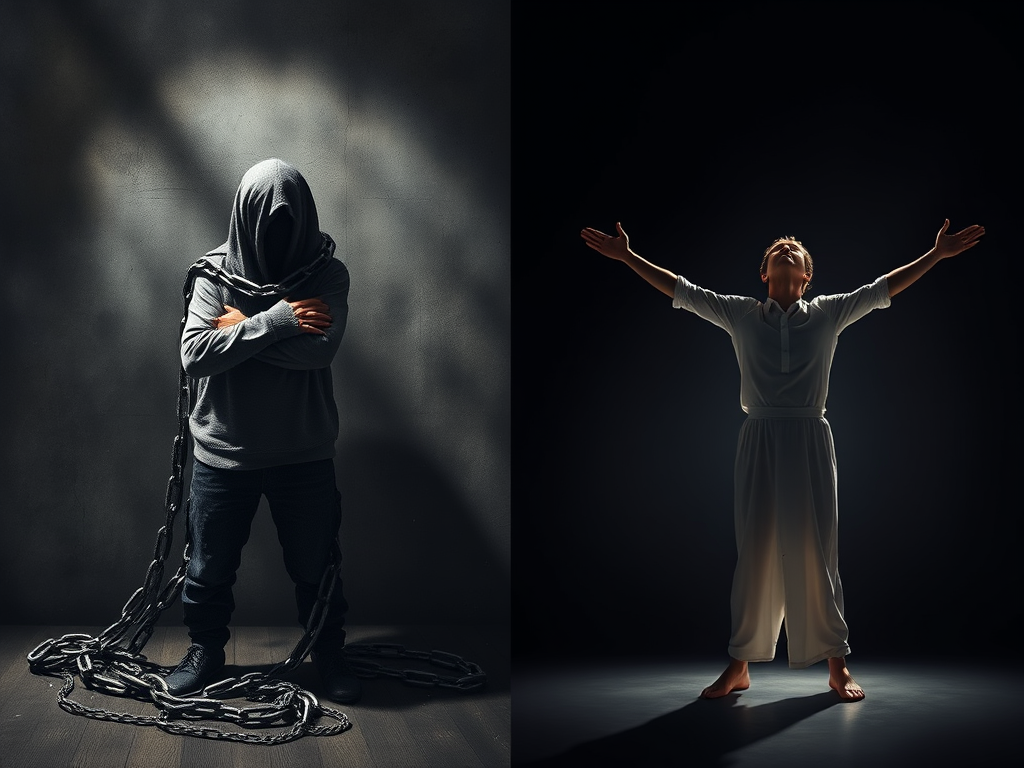
The New Testament speaks about “weakness” in more than one way. Even in my blog you comes across blogs like Why Modern Churches Mislabel Weakness as Holiness and Why Is Grace Perfected In Weakness?
It can be confusing.
Not all weakness is the same.
- Some weakness comes from law-thinking.
- Some weakness comes from faith.
They may look similar on the surface, but spiritually they are opposites.
Let’s walk through all these together:
- Romans (weakness tied to rule-keeping)
- Hebrews (weakness tied to dependence)
- 2 Corinthians (power perfected in weakness)
Once you see it, everything clicks.
Weakness in Romans: When Faith Is Still Mixed with Law
In Romans 14, Paul talks about believers who are “weak in faith.”
These are Christians who:
- feel bound by food laws
- observe special days
- carry sensitive consciences
- rely on external practices to feel spiritually safe
Paul doesn’t shame them — he tells stronger believers to love them patiently.
But he is clear about the root issue:
They are weak in faith.
Not weak emotionally.
Not weak physically.
Weak in their ability to rest in grace.
Their weakness shows up as:
- over-cautious obedience
- insecurity about acceptance
- dependence on rules
- fear of doing the wrong thing
This is law-oriented weakness.
It comes from still relating to God through performance.
This kind of weakness says:
“I must be careful so God stays pleased with me.”
Paul’s goal is not to celebrate this weakness.
His goal is to lead them out of it.
This is weakness that grows from incorrect understanding of grace.
Weakness in Hebrews: When Self-Reliance Is Laid Down
Now look at Hebrews 5.
Here we see Jesus praying with loud cries and tears.
The text says the High Priest is “beset with weakness.”
But this weakness looks nothing like Romans.
Jesus is not insecure before the Father.
He is not worried about acceptance.
He is not clinging to rules.
Instead, He entrusts Himself fully.
He says:
Not My will, but Yours.
This is not weakness of conscience.
This is weakness of surrender.
Jesus enters real humanity.
He refuses self-protection.
He abandons self-reliance.
He places Himself entirely in the Father’s hands.
This weakness is chosen.
It is relational.
It is sonship.
This is faith-oriented weakness.
It says:
“Father, I trust You with everything.”
Hebrews shows us that Jesus was heard because of this surrendered posture.
Not because He tried harder.
Because He yielded completely.
Now 2 Corinthians Brings It All Together
Paul says something revolutionary:
“My grace is sufficient for you, for My power is made perfect in weakness.”
This verse is often misunderstood.
People assume it means:
- sickness
- tragedy
- failure
- suffering itself produces power
But that’s not what Paul is talking about.
Paul had just asked God to remove something he called a “thorn.”
God didn’t remove it.
Instead, He revealed something deeper:
Power flows where self-reliance ends.
Paul responds:
“Therefore I will boast in my weaknesses, so that the power of Christ may rest upon me.”
Notice:
He doesn’t celebrate pain.
He celebrates dependence.
The “weakness” here is not brokenness.
It is coming to the end of yourself.
It is the same posture Jesus modeled in Hebrews.
Grace is perfected not in suffering.
Grace is perfected in surrendered weakness.
When striving stops.
When control is released.
When self-confidence collapses.
That’s where resurrection power rests.
So Now We See the Pattern
Romans weakness:
- clings to rules
- fears losing standing
- tries to stay safe through behavior
Hebrews weakness and 2 Cor
- releases control
- trusts the Father
- abandons self-strength
- boasts in dependence
- welcomes Christ’s power
- lives from grace
Same word.
Very different spiritual realities.
One Weakness Comes from Law The Other Comes from Faith
Romans weakness says:
I must obey carefully so I don’t fall.
Hebrews / Corinthians weakness says:
Father, I place myself entirely in Your hands.
One tries to protect itself.
The other surrenders.
One keeps you small.
The other opens the door to resurrection life.
This Is Why Grace Is Perfected in Weakness
Not weakness as suffering.
Not weakness as failure.
Weakness as the abandonment of self-reliance.
Grace flows freely where control ends.
Power manifests where striving stops.
Life emerges where trust replaces effort.
Adam grasped.
Christ surrendered.
And now, under the New Covenant, we don’t live by managing ourselves.
We live by trusting Him.
Final Summary Line
Not all weakness is the same.
Some weakness comes from trusting rules.
Some weakness comes from trusting God.
Grace is perfected in the second.
Continue reading
Related reading:

Leave a Reply