
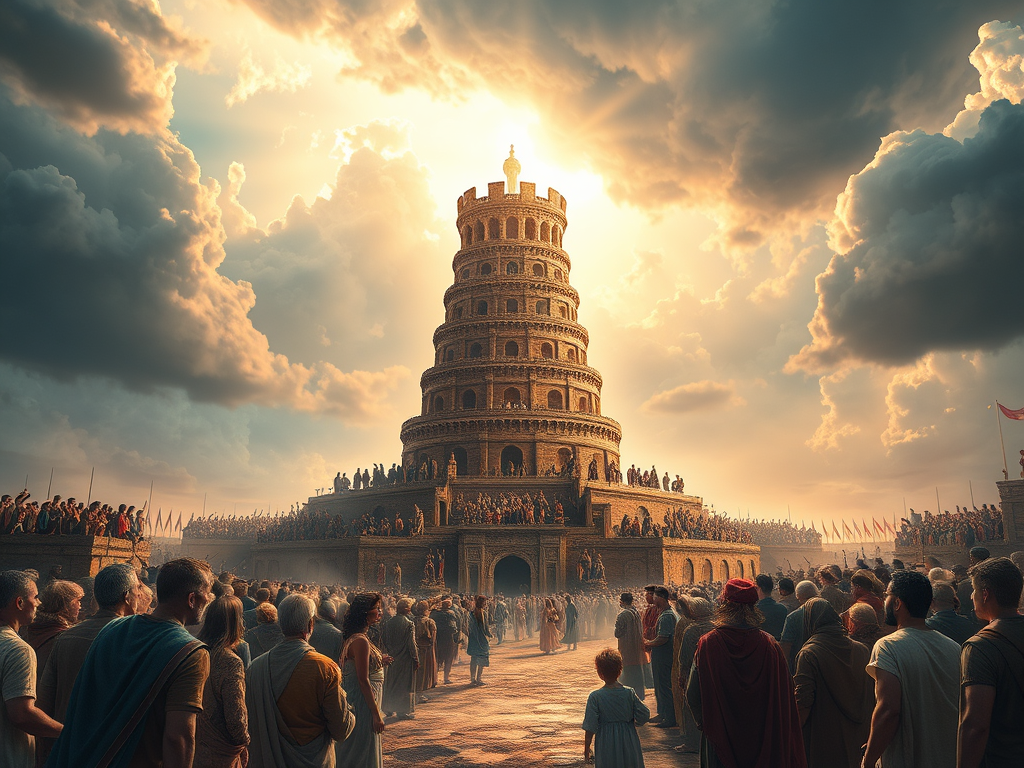
The division of the nations in the Bible is often read as a simple origin story for languages and cultures. But Scripture presents something deeper. When read carefully, the scattering of the nations is not merely descriptive—it is judicial.
Yes, the Bible presents the division of the nations as an act of judgment.
But it is a measured judgment, not abandonment—and it is inseparably connected to God’s plan of redemption.
1. The Rebellion at Babel
The story begins in Genesis 11.
Humanity, unified in language and purpose, declares:
“Let us make a name for ourselves, lest we be dispersed over the face of the whole earth.”
This is not architectural ambition—it is collective defiance. Babel represents a rebellion and a pursuit of autonomy apart from God.
God’s Response
- Confusion of language
- Scattering of peoples
This is not arbitrary. It is judgment meant to restrain unified rebellion.
2. Deuteronomy 32 Explains What Babel Meant
The theological meaning of Babel is explained later in Deuteronomy 32:8–9, preserved in the Dead Sea Scrolls and the Septuagint:
“When the Most High gave the nations their inheritance, when He divided mankind, He fixed the borders of the peoples according to the number of the sons of God. But YHWH’s portion is His people, Jacob His allotted inheritance.”
This passage reveals that:
- The division of humanity was intentional
- The nations were assigned
- Israel was kept directly under YHWH’s rule
This is best described as disinheritance—a judicial act following rebellion.
3. What Kind of Judgment Was This?
This judgment was not destruction, like the Flood.
It was delegation.
God did not cease to be sovereign, but He withdrew direct rule from the nations and allowed them to exist under lesser, created spiritual authorities.
This pattern is consistent with how judgment often works in Scripture:
God “hands people over” to the consequences of their choices (cf. Romans 1).
In effect:
Humanity rejected God’s rule, and God allowed them to live under lesser rulers.
4. Why This Explains the Old Testament So Well
This framework clarifies several recurring biblical themes.
a) Why Israel Is “Chosen”
Israel is not chosen because it is superior, but because God chooses one nation to begin the restoration of all nations.
“It was not because you were more in number… but because YHWH loved you.”— Deuteronomy 7:7
The election of God was for the mission of bringing salvation to all nations.
b) Why the Nations Are Associated with Other “Gods”
Scripture repeatedly speaks of nations serving other gods:
- Deuteronomy 4:19
- Psalms 96:5
- 1 Corinthians 10:20
These are not imaginary deities, nor equals to YHWH. They are created spiritual beings who failed in their stewardship.
c) Why Psalm 82 Is So Severe
In Psalm 82, God judges these rulers:
“You are gods, sons of the Most High… nevertheless, you shall die like men.”
This only makes sense if:
- They had real authority
- That authority was delegated
- Their rule was temporary and accountable
Psalm 82 is judgment on failed stewards, not mythology.
5. Judgment Was Never the Final Word
Immediately after Babel in Genesis comes the call of Abraham:
“In you all the families of the earth shall be blessed.”— Genesis 12:3
This shows the pattern clearly:
Judgment → Election → Restoration
The nations are judged, Israel is chosen, and blessing is promised back to the nations.
6. How the New Testament Reverses the Judgment
The New Testament presents Jesus as the answer to Babel.
- Christ disarms the rulers and authorities— Colossians 2:15
- Christ is exalted above every power— Ephesians 1:20–22
- Pentecost reverses Babel linguistically— Acts 2
- The Great Commission sends the gospel to all nations— Matthew 28:18–20
The nations that were once disinherited are now being reclaimed.
7. A Clear Conclusion
So, did God divide the nations as judgment?
Yes.
But it was:
- Judicial, not arbitrary
- Temporary, not final
- Redemptive in purpose
The Bible’s story does not end with scattered nations under judgment. It ends with redeemed nations under one King.
“The kingdom of the world has become the kingdom of our Lord and of His Christ.” — Revelation 11:15
Judgment explains the fracture. Christ explains the restoration.

Leave a Reply