
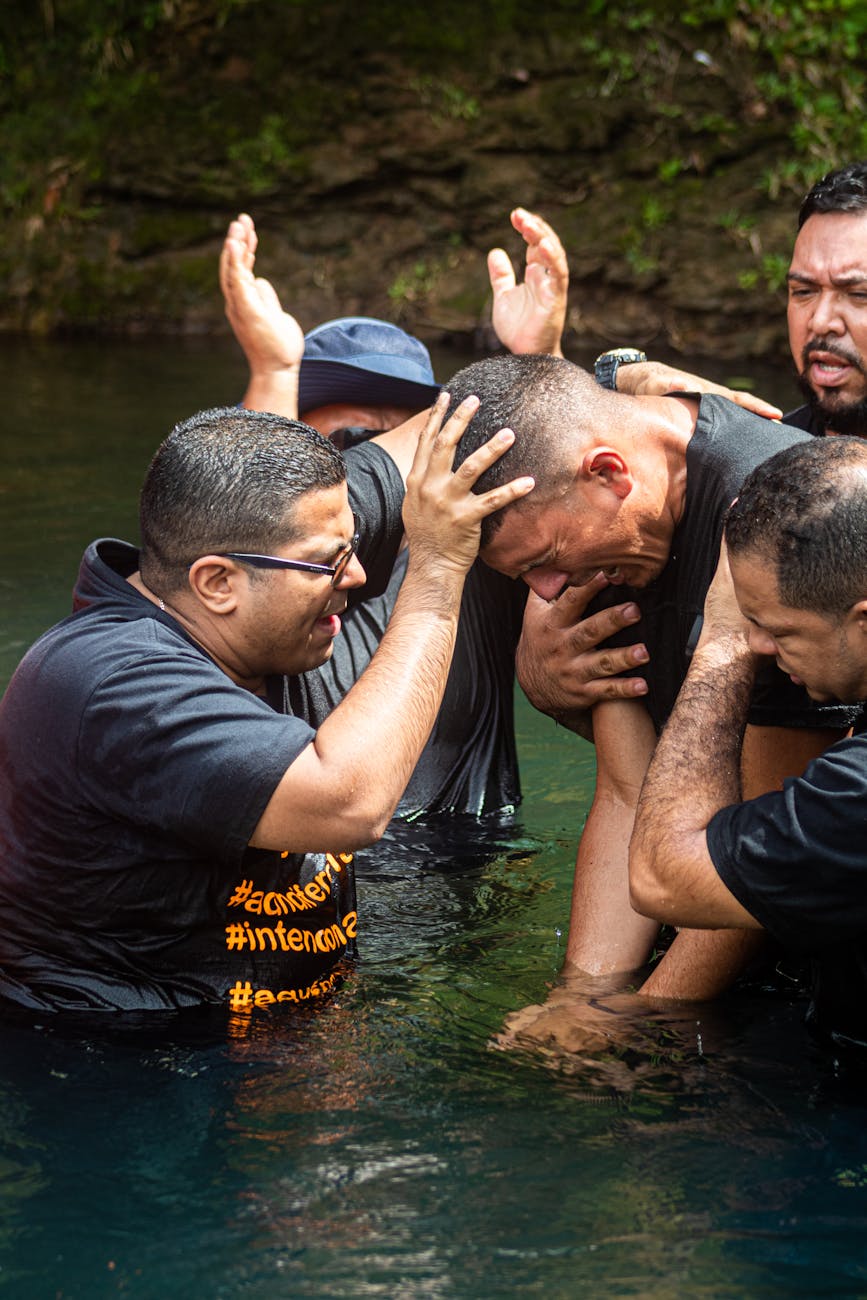
For centuries, sincere Christians have wrestled with the question:
“Is baptism necessary for salvation?”
Those who teach that it is—often called baptismal regenerationists—believe that without baptism, a person cannot be truly saved. They argue their position from certain passages in Scripture that seem, at first glance, to connect baptism directly with salvation.
But as with any biblical doctrine, context is everything. When we read these verses in light of the full gospel message, we see that baptism is not the means of salvation, but the mark of salvation.
Let’s walk through the key verses often used to defend “baptismal salvation,” and see what they really say.
1. Mark 16:16 — “Whoever believes and is baptized will be saved.”
“Whoever believes and is baptized will be saved, but whoever does not believe will be condemned.”
This verse seems to make belief and baptism equally necessary. But look closely — Jesus does not say, “Whoever is not baptized will be condemned.” Condemnation comes from unbelief, not from lack of baptism.
Faith is the condition for salvation; baptism is the confirmation of that faith.
Also, many scholars note that Mark 16:9–20 is not found in the earliest manuscripts. Even if authentic, it must be interpreted consistently with the rest of Scripture, which clearly teaches salvation by grace through faith alone (Ephesians 2:8–9).
2. Acts 2:38 — “Repent and be baptized… for the forgiveness of your sins.”
“Peter replied, ‘Repent and be baptized, every one of you, in the name of Jesus Christ for the forgiveness of your sins. And you will receive the gift of the Holy Spirit.’”
At first glance, this verse sounds like baptism brings forgiveness. But the key word here is “for” — the Greek word εἰς (eis) — which can mean for or because of.
In other words: “Be baptized because your sins have been forgiven.”
The main command Peter gives is “repent.” Throughout Acts, repentance and faith are always the basis for salvation (Acts 3:19; 10:43).
The proof is in Acts 10:44–48, where Cornelius and his household receive the Holy Spirit before being baptized — showing that they were already saved through faith.
3. John 3:5 — “Unless one is born of water and the Spirit…”
“Jesus answered, ‘Truly, truly, I say to you, unless one is born of water and the Spirit, he cannot enter the kingdom of God.’”
Those who argue for baptismal salvation claim “born of water” refers to water baptism. But in context, Jesus is speaking of spiritual rebirth, not ritual baptism.
“Water and Spirit” is a Hebrew parallelism referring to one action — cleansing and renewal by the Holy Spirit. Jesus is drawing from Ezekiel 36:25–27, where God promises to cleanse His people and give them a new Spirit.
So the “water” here is symbolic of purification, not literal baptism.
4. 1 Peter 3:21 — “Baptism now saves you.”
“Corresponding to that, baptism now saves you—not the removal of dirt from the flesh, but an appeal to God for a good conscience—through the resurrection of Jesus Christ.”
At first, this verse seems to say baptism literally saves. But Peter immediately qualifies it:
“Not the removal of dirt from the flesh.”
In other words, not the water itself, but what baptism represents — faith in the risen Christ — is what saves.
Peter explains that baptism “saves” as an appeal to God for a clean conscience. The saving power is not in the ritual, but in the resurrection it symbolizes.
5. Acts 22:16 — “Be baptized and wash away your sins.”
“And now why do you wait? Rise and be baptized and wash away your sins, calling on his name.”
Ananias told Paul to be baptized and wash away his sins. But again, notice the phrase “calling on His name.”
Paul’s sins were washed away not by the water, but by calling on Jesus — the same truth Paul later affirms in Romans 10:13:
“Everyone who calls on the name of the Lord will be saved.”
In Greek, the “washing” and “calling” are connected — showing the cleansing is spiritual, not ceremonial.
Read more in Does Acts 22:16 Teach That Baptism Washes Away Sins?
6. Titus 3:5 — “He saved us through the washing of regeneration.”
“He saved us, not because of works done by us in righteousness, but according to His mercy, by the washing of regeneration and renewal of the Holy Spirit.”
Some interpret “washing of regeneration” as baptism. But Paul clearly says salvation is not because of works — and baptism is a work.
The “washing” here refers to the inner cleansing of the Spirit at the moment of salvation.
It’s the same image Paul uses in Ephesians 5:26:
“…cleansing her by the washing with water through the word.”
So this is spiritual cleansing, not a ritual act.
7. Galatians 3:27 — “All of you who were baptized into Christ have clothed yourselves with Christ.”
This sounds like baptism unites us with Christ — but Paul is referring to Spirit baptism, not water baptism.
1 Corinthians 12:13 clarifies:
“For in one Spirit we were all baptized into one body.”
When you believed, the Spirit placed you into Christ.
Water baptism simply symbolizes that union.
8. Romans 6:3–4 — “We were baptized into His death.”
“All of us who were baptized into Christ Jesus were baptized into His death. Therefore we were buried with Him through baptism into death…”
Again, this is spiritual baptism — being united with Christ through faith.
Water baptism illustrates that reality, but doesn’t cause it.
If baptism literally caused salvation, then Paul’s statement that “Christ did not send me to baptize but to preach the gospel” (1 Corinthians 1:17) would contradict the very message of salvation.
The Heart of the Gospel
When these passages are read in context, the message is consistent:
- Salvation is by grace through faith.
- Baptism follows salvation as obedience.
- The water doesn’t save — the blood does.
Baptism is a public declaration, not a prerequisite.
It’s an act of faith, not a formula for forgiveness.
“Whoever believes in Him shall not perish but have eternal life.” — John 3:16
No water can add to what the cross has already accomplished.
Final Thought
To say “you must be baptized to be saved” may sound serious or holy, but it subtly denies the sufficiency of the cross.
It makes salvation dependent on our act rather than Christ’s finished work.
The truth is simple, and beautiful:
We are saved by grace, through faith, in Christ alone.
Baptism is our response to that grace — not the requirement for it.
The water testifies; it doesn’t qualify.
Continue reading
Related reading:
2 responses to “Understanding the Verses Used to Support Baptismal Salvation”
-
If that is true, then why bring up baptism at all ? Why all the fuss ?
Why introduce something that is going to cause such a controversy when it isn’t necessary?
When Christ was baptized , doesn’t John ask why he should baptize him
and Christ answer “So that all righteousness be fulfilled “ ?
Why bother ?
Why do something that is going to create confusion ?When Paul was blinded , wasn’t he told to go into town where he would be told what he must do to be saved ? Cleatly , he believed already .
God would know if there was anything actually preventing a person from being baptized and I’m sure he would take that into account .
So why teach people that they can take it or leave it when every account of New Testament salvation includes it ?
Since you can’t be saved through your own works why not call the act of baptism a work of God and simply do the one thing you CAN do which is to OBEY the one command you CAN perform whether you think it’s symbolic or not ?
After all , the gospel isn’t a product of our opinion . It is the WORK of God .
I’m not trying to take credit for any part of it. But if baptism is a “work “ , isn’t believing also?
Telling people which parts are optional seems like playing fast and loose to me and also seems quite dangerous if we believe that we are all saved “ by the skin of our teeth “ to begin with , which I frankly do.Why not advise people to not take any chances and just do what they are commanded whether they understand everything about it or not ?
It just seems like too big a risk to me to want to gamble with my soul based on what seems reasonable to me .Personally , I view baptism as the single most thing I CAN do for the simple reason that if my salvation was based on MY WORKS I would be damned because I’ve already sinned. If it’s contingent upon my being “ good “ I’ve already messed that up way beyond repair.
That’s the whole argument of the devil with regard to my soul and I imagine it’s the same with others , namely ; that we HAVE sinned and that he has a righteous claim on us . Isn’t that the argument he is purported to make continuously before God day and night?
If you’re looking for something hard to understand why not ask HOW the blood of Christ erases that FACT. If I was going to quibble it would be over that . But why look a gift horse in the mouth when you’re only a bigger to begin with in sore need of a ride?
No ! I’m not dickin’ around with it !
I’m too close to hell already . I’ve had a taste of it and I don’t like it at all .I consider that one act of submission and obedience the only thing I have standing between me and the devil and I’m not snuffing at it .
Don’t get me wrong either . I’m not fool enough to think that gives me a license to do anything either .
I’m doing my dead level best to “be good “ all the time as my time runs out .
Why? Because I repent ! My misconduct and bad words have caused me immense grief .So my advice to anyone would be just to do the thing that IT SEEMS like it’s saying and not take any chances.
Isn’t that the only hope of life that ANY of us has? Why try to dice and slice your way around it when it seems like such a generous and lenient offer already ?
Of all the schemes and explanations that men have conjured up I don’t see any other that make more sense . Do you ?
That’s the only hope that does not seem to be an invention of man.It has a history rooted in actual events . More importantly, these events are not a matter of private interpretation .
Granted , I’m forced to make one . Aren’t we all? I’m making mine in fear and trembling .
I’m sorry if that strikes you as a lack of confidence . I gave up on my own understanding a long time ago . -
So why mention baptism at all ?
If it’s not being submerged in water , then what is it?
Maybe it’s an act of obedience.
But why obey anything you don’t understand ?It’s simple enough to do. But it doesn’t conform to the wisdom of some men , who purport to know better . So why bother doing the one simple thing we can do and rather bank on the many things we can’t? (Lord help thou my unbelief.)
So we can all safely dismiss it from our minds and ignore the fact that Christ himself was baptized “so that all righteousness be fulfilled”.
Surely he was just putting on a show!It’s spiritual alright. So is believing .
So why isn’t believing a “work”?
Baptism is , right?
You’re saying baptism is “spiritual” . So is believing.
But if you believe in what he says then why don’t you believe that part of what he said? It was just nonessential fluff!So you don’t believe what God said about baptism . So we can ignore it.
That was just a suggestion on his part.
Optional as you would have it.
What other things don’t you understand ? We can safely ignore those too!But it’s surprising to me that God would just arbitrarily toss that in there knowing full well the confusion it would cause many people knowing that some might take him literally.
Some people sure take Revelation literally! A lot is riding on the literal interpretation of that one for sure. And I’m sure I needn’t say what.
No room for symbolism there.
Right?



Leave a Reply